
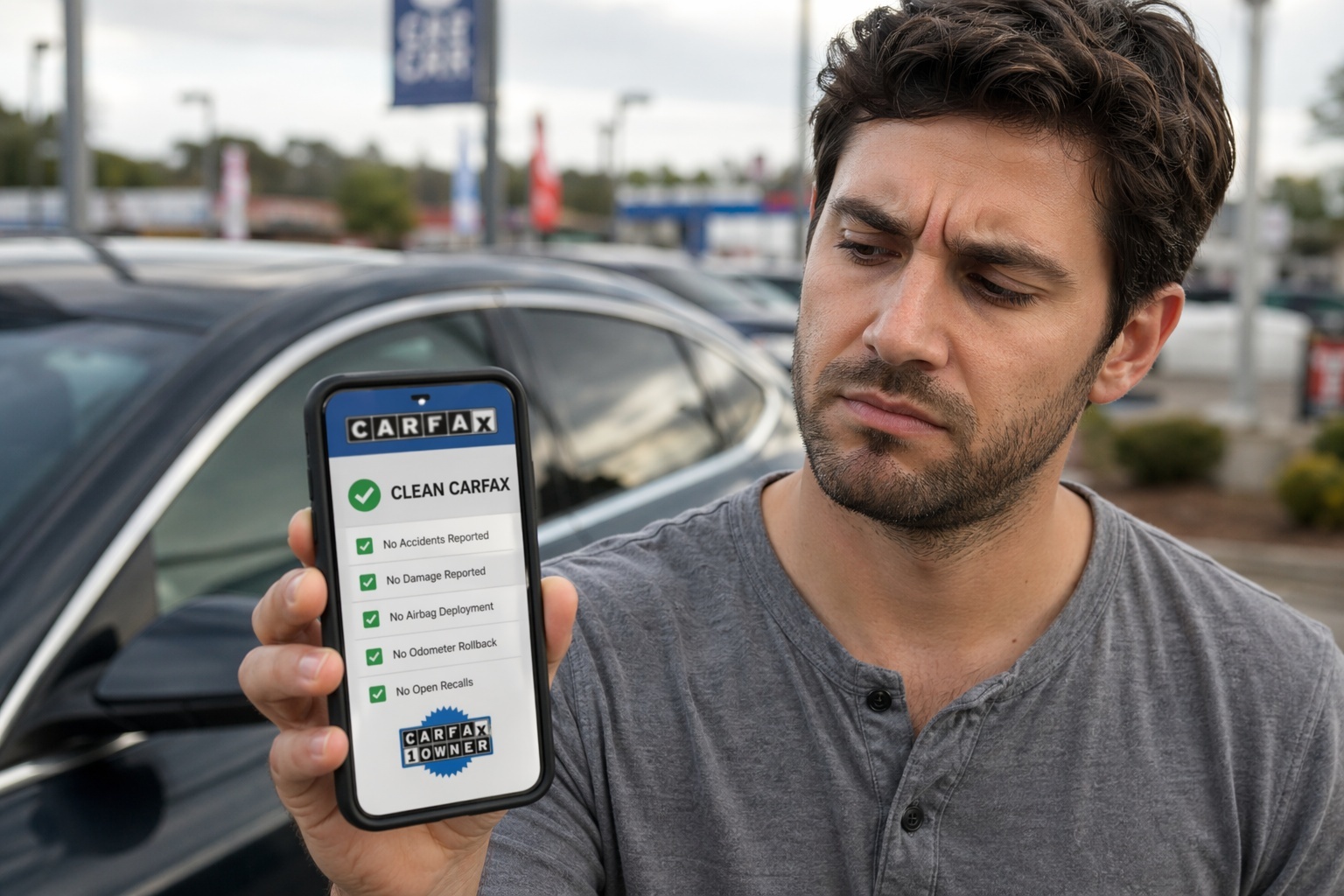
Every used car listing seems to shout it: “Clean Carfax!” Dealers put it in bold. Private sellers drop it like a mic. And buyers treat it like a golden stamp of approval — proof the car has never been touched, crashed, or troubled in any way.
Except that’s not what it means. Not even close.
The phrase “clean Carfax” has become one of the most misunderstood terms in used car buying. And that misunderstanding has cost countless buyers real money on vehicles they assumed were perfect — because a report told them what they wanted to hear.
Quick Answer: What Does “Clean Carfax” Mean?
A “clean Carfax” means the vehicle’s Carfax history report shows no reported accidents, no title brands (such as salvage, rebuilt, or flood), and no other major negative entries. It indicates that none of Carfax’s data sources — insurance companies, DMVs, police departments, and participating repair facilities — have flagged any significant issues for that VIN.
What it does NOT mean: A clean Carfax does not guarantee the car has never been damaged, never been in a collision, or has no hidden mechanical problems. It means nothing negative was reported to Carfax’s database. Those are two very different things.
That distinction is everything.
What a Clean Carfax Report Includes
When someone says a car has a “clean Carfax,” they’re generally referring to a report that shows:
- No reported accidents — No insurance claims or police reports involving a collision have been recorded.
- Clean title — The vehicle has never been branded as salvage, rebuilt, flood, lemon, or junk by any state’s DMV.
- No airbag deployments — No record of airbags being triggered, which would indicate a significant impact.
- No structural damage — No reports of frame or unibody damage from any participating source.
- No odometer rollback — Mileage readings have been consistent and show no signs of tampering.
- No theft record — The vehicle hasn’t been reported as stolen.
- Consistent ownership history — Title transfers, registration changes, and state history appear logical and sequential.
On paper, that looks reassuring. And in many cases, it genuinely is. A clean Carfax eliminates some of the worst potential risks — salvage history, odometer fraud, stolen vehicles. That’s valuable information.
But it’s only part of the picture.
What a Clean Carfax Does NOT Tell You
This is where the blind spots start to matter, and where too many buyers get caught off guard.
Unreported Accidents
If a collision occurred and no one filed an insurance claim, no police report was made, and the repair was handled at a shop that doesn’t report to Carfax — the accident won’t appear. The car could have been T-boned in a parking lot and completely repaired out of pocket, and the Carfax would still come back clean.
Cash Repairs at Independent Shops
The majority of independent auto body shops have no data-sharing relationship with Carfax. An owner who pays $4,000 in cash for front-end repair at a local shop leaves zero trace in the Carfax database. This happens far more often than most buyers realize.
Mechanical Problems
Carfax tracks events — accidents, title changes, service visits at participating shops. It does not diagnose mechanical condition. A car with a clean Carfax could have a failing transmission, a head gasket leak, or worn suspension components. The report won’t tell you any of that.
Flood Damage Without a Title Brand
After major flooding events, some vehicles get cleaned up and moved to states where they can be re-titled without a flood brand. The National Insurance Crime Bureau (NICB) has repeatedly warned consumers about flood-damaged vehicles being laundered through title washing. A clean Carfax doesn’t always catch these.
Cosmetic Cover-Ups
Repainting, interior detailing, and cosmetic repairs that mask wear, damage, or neglect won’t show up on Carfax unless they were performed at a reporting facility. A car can look showroom-fresh and have a spotless history report while hiding significant cosmetic restoration.
How Carfax Collects Its Data
Understanding where Carfax gets its information explains why clean reports have limitations.
Carfax aggregates data from over 100,000 sources, including:
- Insurance companies (the largest source of accident data)
- State DMVs and motor vehicle agencies
- Police departments and law enforcement
- Auto auction companies
- Franchise dealership service departments
- Some collision repair facilities (voluntarily)
- Fleet and rental companies
- Canadian vehicle registries
What’s conspicuously absent from that list? Independent mechanics, non-participating body shops, private repair transactions, and the guy down the street who fixes cars in his garage. If a vehicle’s damage or repair history flows exclusively through those channels, Carfax has no way to capture it.
The system is built on reported data. And reported data, by definition, has gaps.
Why a Clean Carfax Can Be Misleading

This isn’t about bashing Carfax — their reports provide genuine value and have saved countless buyers from serious mistakes. But the marketing phrase “clean Carfax” creates a false sense of completeness that sellers exploit, intentionally or not.
Here’s how a clean Carfax can lead you astray:
Sellers Use It as a Shield
“It has a clean Carfax” has become the universal answer to every question a buyer might ask. Concerned about that mismatched fender? Clean Carfax. Wondering why the paint looks different on the driver’s door? Clean Carfax. Suspicious of the price? Clean Carfax.
Some sellers genuinely believe a clean report means the car is perfect. Others know exactly what the report doesn’t show and use it strategically. Either way, accepting “clean Carfax” as a complete answer shuts down the critical thinking you need as a buyer.
Title Washing Exploits Reporting Gaps
Unscrupulous sellers move damaged vehicles across state lines to “wash” problematic titles. A car branded as salvage in Texas could potentially be re-titled clean in another state with less stringent reporting. The Carfax may or may not catch this, depending on how quickly data flows between state databases.
Timing Gaps in Reporting
Data doesn’t flow into Carfax in real time. There can be weeks or even months between an event occurring and the information appearing on a report. A car could have been in an accident last month, and the Carfax pulled today might not reflect it yet.
Clean Carfax vs. No Accidents vs. Verified History
| Term | What It Means | Reliability Level |
|---|---|---|
| Clean Carfax | No negative entries in Carfax’s database | Good — but limited to reported data only |
| “No Accidents” | No accidents reported to Carfax’s sources | Moderate — unreported accidents won’t appear |
| Verified History | VIN checked across multiple databases + physical inspection + documentation | High — combines digital records with real-world verification |
The takeaway is clear: a clean Carfax is a good start, but verified history — where you cross-reference reports with physical evidence and professional inspection — is the standard you should aim for.
Real-Life Scenarios Where Clean Carfax Wasn’t Enough
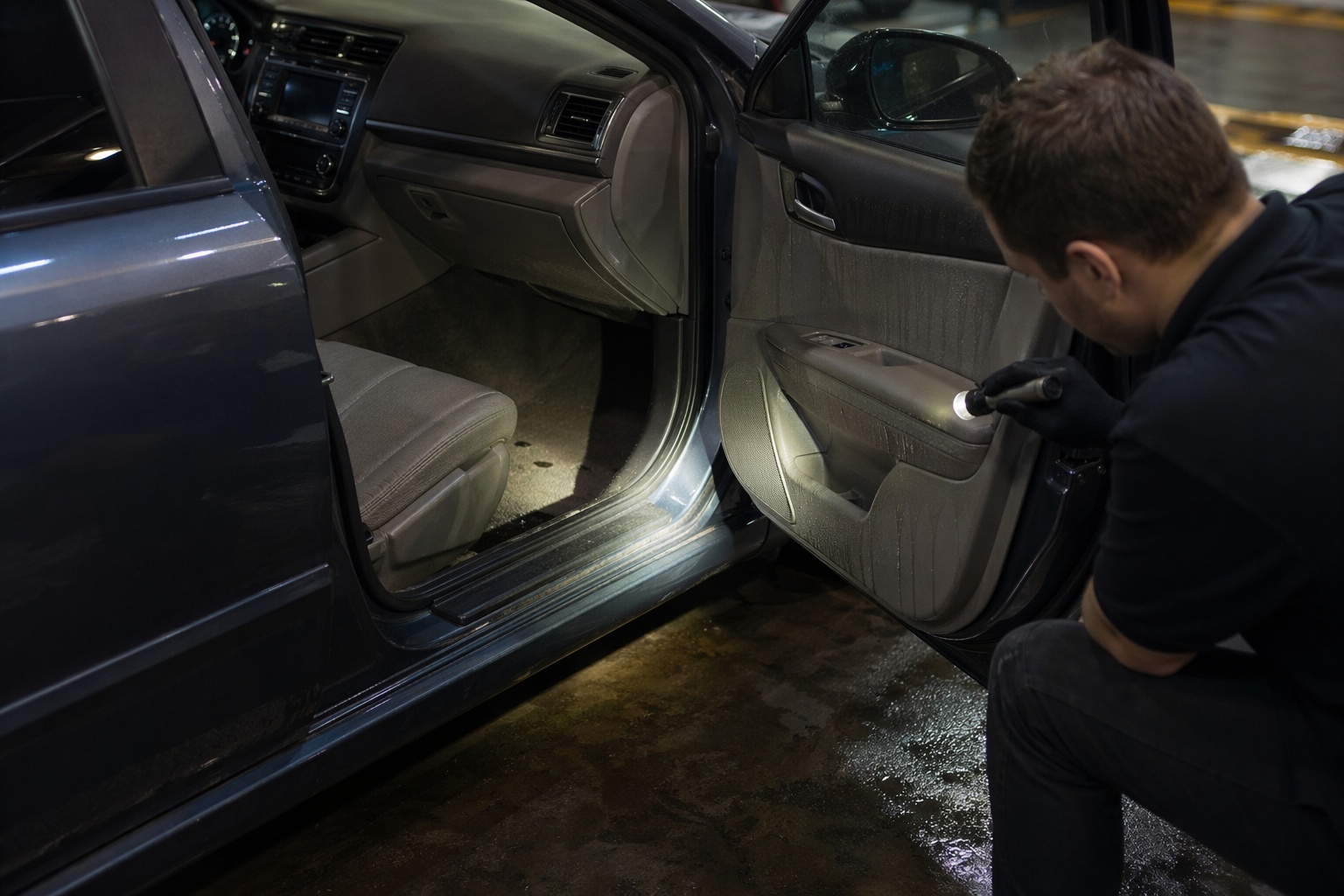
Scenario 1: The Washed Flood Car
A buyer purchased a 2020 sedan with a clean Carfax from an out-of-state seller. Six months later, electrical gremlins started — random warning lights, corroded wiring harnesses, mildew smell from the vents in humid weather. An independent mechanic found water staining under the carpet and mud residue in places that don’t get wet from normal use. The car had been through a flood, cleaned up, re-titled in a different state, and sold with a spotless Carfax report.
Scenario 2: The Repaired Front End
A buyer asked about a slight color difference on the hood of a truck. The seller pointed to the clean Carfax as proof nothing had happened. The buyer got a pre-purchase inspection anyway. The mechanic found aftermarket headlights, a non-factory radiator support, and paint thickness readings three times higher than normal on the entire front clip. The truck had been in a significant front-end collision repaired entirely out of pocket.
In both cases, the Carfax was technically accurate — nothing had been reported. But the Carfax was also completely useless in revealing the car’s actual history.
Trust a Clean Carfax If:
- The report shows consistent service history at franchise dealerships
- Ownership timeline is logical — no rapid flips or out-of-sequence registrations
- The physical condition matches the report’s story
- A pre-purchase inspection reveals no hidden repair work
- You’ve cross-referenced the VIN through a service that lets you check vehicle history and other history services
- The seller’s answers are specific, confident, and consistent
Do NOT Rely On It If:
- The car shows physical signs of repair work that the report doesn’t mention
- The vehicle was recently imported or re-titled from another state
- There are gaps in the ownership or service history
- The seller deflects every question with “it has a clean Carfax”
- The price seems unusually low for the car’s apparent condition and specifications
- You haven’t had the vehicle inspected by an independent mechanic
Myth vs. Truth
Myth: A clean Carfax means the car has never been in any accident.
Truth: It means no accident has been reported to Carfax’s network of data sources. Out-of-pocket repairs, incidents that didn’t involve insurance or police, and work done at non-participating shops will not appear — regardless of how severe the damage was.
Myth: Everything that happens to a car shows up on Carfax.
Truth: Carfax captures a significant amount of data, but it’s far from everything. Their own disclosures acknowledge that not all accidents and damage events are reported. Independent shop repairs, private-party incidents, and some state records simply don’t flow into their system.
Myth: If two reports disagree, the clean one is correct.
Truth: Different vehicle history services access different databases. If one report shows something another doesn’t, the additional information is almost certainly real — someone reported it, and it appeared in that provider’s data. Always treat the more detailed report as the more complete one.
Myth: Dealers only sell cars with clean Carfax — those are the safe ones.
Truth: Dealers sell cars with all types of histories, and many use “clean Carfax” as a selling point because it’s effective marketing. A clean Carfax at a dealer doesn’t replace the need for your own inspection and research. Some of the most problematic vehicles on used car lots have perfectly clean reports.
Pro Tips for Verifying Beyond the Carfax
- Run the VIN through multiple services. Different providers pull from different databases. CarfaxVINLookup.com aggregates information that can surface entries missed by a single source. Cross-referencing catches more discrepancies than relying on one report alone.
- Inspect the VIN stickers. Every vehicle has VIN labels on the door jamb, under the hood, and sometimes on glass. If any of these look replaced, peeled, or don’t match, something isn’t right — clean Carfax or not.
- Check the trunk and spare tire well. Repair work often focuses on what’s visible. Lift the trunk carpet, pull back floor panels, and look for wrinkled metal, mismatched sealant, or evidence of welding. These areas reveal collision history that even reports miss.
- Use a paint thickness gauge. For $30–$50, you can check every panel on the car. Factory paint has consistent thickness — typically 100–150 microns. Any panel reading 200+ microns has been repainted. Multiple repainted panels on a “clean Carfax” car is a serious red flag.
- Ask the seller pointed questions. Instead of “has the car been in an accident?” — which gets a reflexive “no” — ask “which panels have been repainted?” or “has any body work been done?” Specific questions get more honest answers.
The Smartest Approach for Any Buyer
Treat a clean Carfax as one piece of a larger puzzle. It tells you what’s been reported — and that’s valuable. But it doesn’t tell you what hasn’t been reported, and that gap is where buyers get burned.
Start by running the vehicle’s VIN through CarfaxVINLookup.com to get a comprehensive history report. Then verify what you find with a physical inspection and a professional mechanic’s evaluation. When the report, the physical evidence, and the mechanic all tell the same story, you can buy with confidence.
Frequently Asked Questions
What does “clean Carfax” actually mean?
A clean Carfax means the vehicle’s history report shows no reported accidents, no title brands (salvage, rebuilt, flood), no odometer issues, and no other major negative entries from Carfax’s network of over 100,000 data sources.
Does a clean Carfax guarantee no accidents?
No. A clean Carfax means no accidents were reported to their database. Incidents handled without insurance claims, police reports, or participation from reporting facilities will not appear — even if significant damage occurred and was repaired.
Can a car have damage and still show a clean Carfax?
Yes. If the damage was repaired out of pocket at a non-reporting shop, or if no insurance claim or police report was filed, the damage will not appear on the Carfax report. The car could show a clean history despite having a substantial repair history.
Should I still get an inspection if the Carfax is clean?
Absolutely. A pre-purchase inspection by an independent mechanic is recommended for every used car purchase, regardless of the Carfax results. The inspection catches mechanical issues, hidden repairs, and physical problems that no history report can detect.
Is a clean Carfax better than other vehicle history reports?
Not necessarily better or worse — just different. Different services access different databases. The smartest approach is to check vehicle history through multiple sources, including CarfaxVINLookup.com, to get the most complete picture available.
Why do some cars show clean Carfax but have obvious signs of repair?
Because the repairs were likely done without triggering any of Carfax’s data sources. Out-of-pocket repairs at independent shops, private settlements between drivers, and incidents that didn’t involve police or insurance all bypass the reporting system entirely.
Can a Carfax report be wrong or incomplete?
Yes. Carfax acknowledges on their own reports that not all events are captured. Data reporting is voluntary for many sources, timing delays exist, and some state records may not be fully integrated. The report is comprehensive but not infallible.
The Bottom Line
A clean Carfax is a useful data point that eliminates some of the worst risks in used car buying — salvage histories, odometer fraud, and documented collisions. It’s genuinely valuable, and you should always check a vehicle’s history before purchasing.
But treating a clean Carfax as a complete guarantee of a vehicle’s condition is a mistake that costs real money. The phrase “clean Carfax” tells you what’s been reported. It says nothing about what hasn’t been.
Before you make your decision, run a comprehensive VIN check at CarfaxVINLookup.com, get the car inspected by a mechanic you trust, and look at the vehicle with your own eyes. If you want to start screening vehicles before paying for a full report, explore your free vehicle history report alternatives first. When all three sources agree, you’ve got a car worth buying. When they don’t, you’ve got a reason to keep looking.