

You found a car you like. The seller proudly hands you a Carfax report — or maybe you pulled one yourself. Now you’re staring at pages of entries, icons, dates, and terminology that might as well be written in another language. “Accident Reported.” “Vehicle Reconditioned.” “New Owner Reported.” What does any of it actually mean for your decision?
Here’s the thing most buyers don’t realize: a Carfax report is incredibly useful, but only if you know how to interpret it. The information is all there — the problem is that most people scan the summary at the top, see a green checkmark, and assume everything is fine. That’s exactly how buyers end up with flood-damaged sedans, title-washed trucks, and cars hiding thousands of dollars in unreported body work.
This guide breaks down every section of a Carfax report, explains what actually matters, and shows you exactly where sellers hope you won’t look closely enough.
Quick Answer: How to Read a Carfax Report Step by Step
If you’re short on time, here’s the essential process:
- Start with the title section. Check for salvage, rebuilt, flood, or lemon law brands. Any of these is a major red flag.
- Count the owners and check the timeline. Frequent ownership changes in short periods can signal problems the report doesn’t explicitly state.
- Read every accident entry carefully. Don’t just note that an accident occurred — look at the severity, which areas were damaged, and whether airbags deployed.
- Review the service history. Consistent maintenance at the same facility suggests a well-cared-for vehicle. Gaps or sudden facility changes deserve questions.
- Check the odometer readings. Look for logical progression. Any rollback or inconsistency is a deal-breaker.
- Look at the last reported mileage and date. A large gap between the last entry and today’s date means you don’t know what happened during that period.
That’s the overview. Now let’s dig into what each section really tells you — and what it doesn’t.
What a Carfax Report Actually Includes
A standard Carfax report is built from data collected across over 100,000 sources — insurance companies, state DMVs, dealerships, auction houses, and law enforcement agencies. That sounds comprehensive, and in many ways it is. But understanding what’s included helps you recognize what might be missing.
A typical report covers:
- Title history — Current title status, state of registration, and any title brands (salvage, rebuilt, flood, etc.)
- Ownership timeline — Number of previous owners and the type of use (personal, fleet, rental, commercial)
- Accident history — Reported accidents with severity classifications and damage locations
- Service and maintenance records — Oil changes, brake work, tire rotations, and other service performed at participating facilities
- Odometer readings — Mileage recorded at each reported event
- Recall information — Open and completed manufacturer recalls
- Registration history — States where the vehicle was registered and any registration events
How to Read Each Section of a Carfax Report
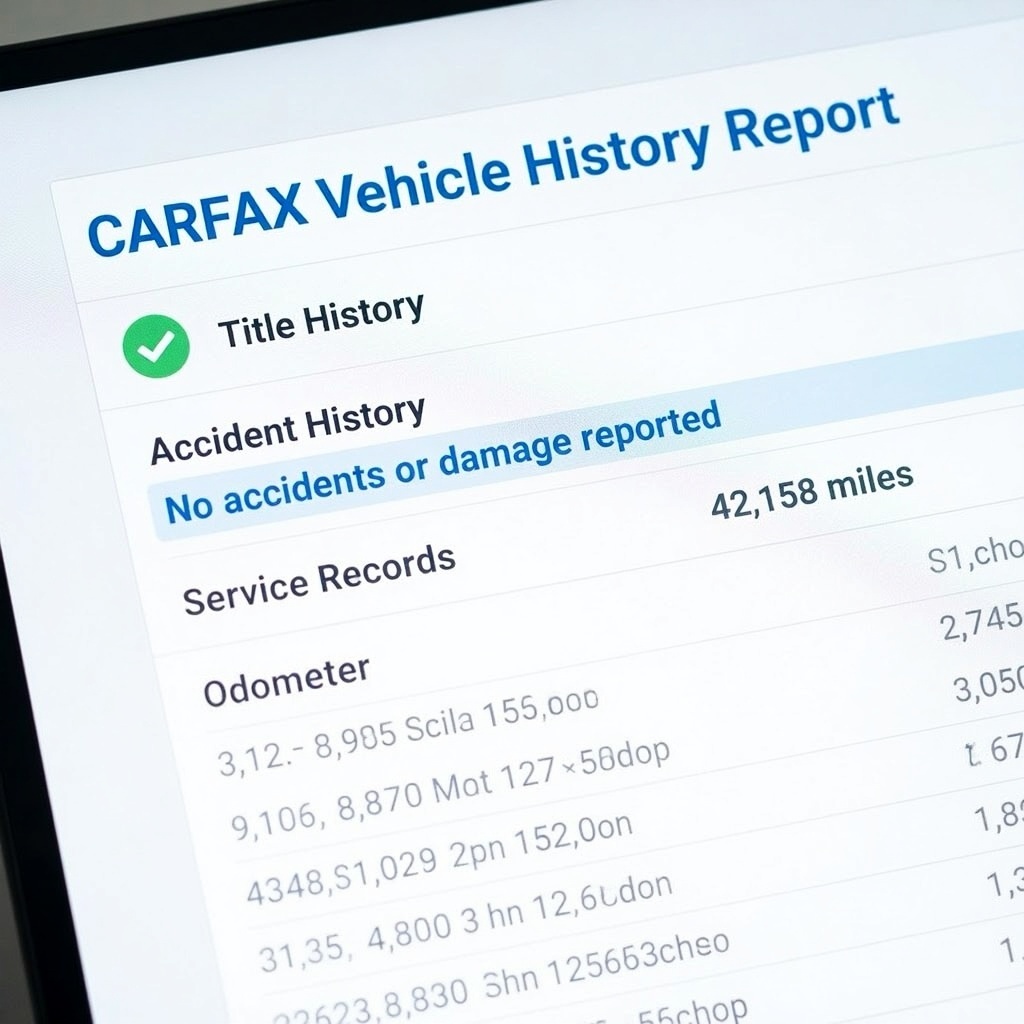
Title and Registration
This is the first section you should examine, and it’s the one with the highest stakes. A clean title means the vehicle has never been declared a total loss by an insurance company or branded by a state agency. That’s what you want to see.
What you’re watching for: salvage titles, rebuilt titles, flood damage brands, lemon law buybacks, and junk designations. Any of these means the vehicle experienced something severe enough for an official agency to flag it permanently. Some buyers are comfortable purchasing rebuilt title vehicles at a significant discount — but you need to know before you negotiate, not after.
Also pay attention to where the car has been registered. A vehicle that spent years in a coastal or flood-prone area and then was moved to an inland state deserves extra scrutiny, especially if there’s a gap in the reporting timeline.
Ownership History
The number of owners alone doesn’t tell the whole story. A ten-year-old car with three owners isn’t unusual. A three-year-old car with four owners is a pattern worth questioning.
Look at how long each owner kept the vehicle. Short ownership periods — especially under a year — can indicate the car had recurring problems that each owner discovered and passed along. Also note the type of use. Fleet and rental vehicles get driven hard but are often maintained on strict schedules. Personal-use vehicles vary wildly depending on the owner.
Accident History
This is where most buyers focus, and rightfully so. But the mistake people make is treating all accident entries equally. They’re not.
When you see “Accident Reported,” look at three things:
- Severity — Carfax classifies damage as minor, moderate, or major. Understanding what minor damage on a Carfax report really means can save you from walking away from a perfectly good car — or from underestimating a serious one.
- Location of damage — Front, rear, left side, right side. Front and side impacts affecting structural components are more serious than rear bumper contact.
- Airbag deployment — If airbags deployed, the impact was significant regardless of how the damage is classified. This also means the vehicle required expensive supplemental restraint system repairs.
A single minor rear-end incident with professional repair documentation is very different from multiple front-end collisions with airbag deployment. Context matters more than the number of entries.
Service Records
Consistent service records are one of the most reassuring things you can find on a Carfax report. Regular oil changes, brake replacements, and scheduled maintenance performed at the recommended intervals suggest an owner who cared about the vehicle’s longevity.
Watch for these patterns:
- Sudden stops in maintenance records — If detailed records exist for years and then abruptly end, the vehicle may have changed hands informally or started being serviced at non-reporting facilities.
- Dealership vs. independent shop records — Franchise dealership records appear on Carfax consistently. Independent mechanic visits usually don’t, which means a gap in service records doesn’t necessarily mean a gap in maintenance.
- Reconditioning entries — If you see “Vehicle Reconditioned,” it typically means a dealer performed standard preparation before resale. It’s worth understanding but rarely a cause for concern on its own.
Odometer Readings
Scroll through the timeline and watch the mileage progression. It should increase steadily over time. The National Highway Traffic Safety Administration (NHTSA) estimates that odometer fraud affects more than 450,000 vehicles sold each year in the United States.
Red flags include:
- Mileage that decreases between entries (rollback)
- An “Odometer Discrepancy” notation (not always fraud — sometimes a data entry error, but always worth investigating)
- Unusually low mileage for the vehicle’s age with no supporting data to explain why
Red Flags That Buyers Commonly Miss

Most people know to look for accidents and title problems. But experienced buyers pay attention to subtler signals that often get overlooked:
- Auction sales between owners. If a vehicle passed through auction — especially a dealer-only auction — it may have been traded in and deemed not worth selling directly. Dealers typically send problem vehicles to auction.
- State changes after damage events. A vehicle that was in an accident in one state and then quickly re-registered in another could be the result of title washing — moving the car to a state with weaker reporting requirements.
- Long gaps with no entries. Silence on a Carfax report isn’t the same as nothing happening. It just means nothing was reported. The car could have been sitting, or it could have been driven extensively with all work done at facilities that don’t share data with Carfax.
- Structural damage notation. Some reports specifically note whether structural components were affected. This is buried in the detail section and easy to miss, but it’s one of the most important pieces of information on the entire report.
What Matters vs. What Doesn’t
| Usually Matters | Usually Doesn’t Matter |
|---|---|
| Salvage or rebuilt title brand | Single minor rear-end incident with proper repair |
| Airbag deployment | Multiple owners over 10+ years |
| Structural damage reported | “Vehicle Reconditioned” entry from a dealer |
| Odometer discrepancy or rollback | Gaps in service records (independent shop use) |
| Flood damage brand | Registration renewal or emission inspection entries |
| Multiple accidents in short timeframe | Single-owner vehicle with normal wear events |
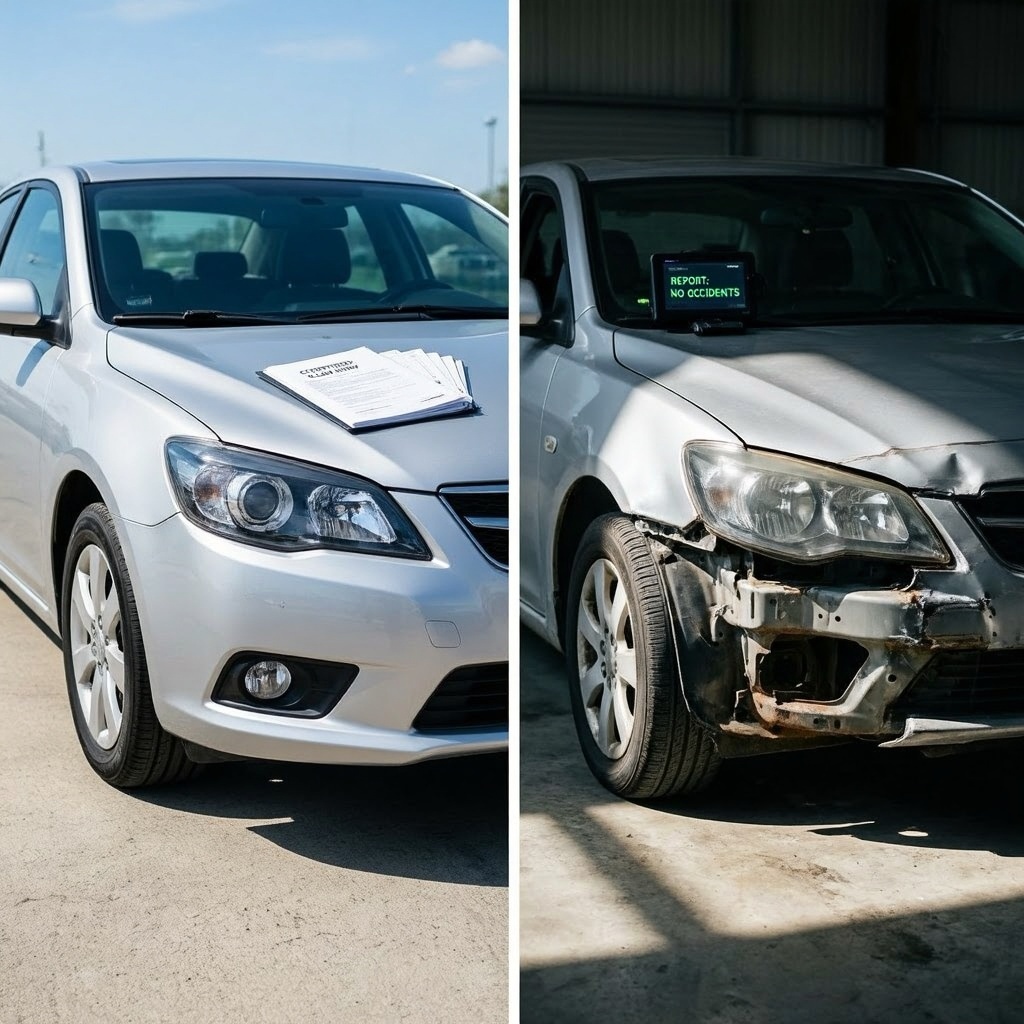
The biggest mistake buyers make is treating every entry as equally alarming. A car with one documented minor fender-bender and ten years of clean service records is likely a better purchase than a car with zero entries and no service history. The first car has evidence of care. The second has evidence of nothing — and that’s not the same as evidence of perfection.
How Sellers Can Hide Issues
A clean-looking Carfax report doesn’t always mean a clean vehicle. Here’s how issues slip through:
Cash repairs at non-reporting shops. The majority of independent body shops don’t report to Carfax. An owner who pays out of pocket for significant repair work at a local shop leaves zero trace in the database. The car could have been in a serious collision and repaired beautifully — or poorly — with nothing on the report to indicate it.
Private insurance settlements. When two parties agree to handle an accident without involving insurance companies, no claim gets filed and nothing reaches Carfax. This is especially common with low-to-moderate damage where both parties prefer to avoid premium increases.
Title washing across state lines. Some sellers exploit differences in state titling requirements to remove salvage or flood brands from a vehicle’s record. While Carfax catches many of these through their NMVTIS integration, the system isn’t perfect — especially with vehicles moved quickly between states with less rigorous reporting.
Good Report vs. Risky Report: Real-Life Scenarios
Scenario A: The Well-Documented Car
A 2018 Honda Accord with two owners. First owner kept it for five years with dealership service records every 5,000 miles — oil changes, tire rotations, brake pads replaced at 45,000 miles. Second owner purchased it at 62,000 miles, continued servicing at a different dealership. One minor damage report from a parking lot incident at 38,000 miles. No structural damage. No airbag deployment. Clean title. Current mileage: 89,000.
Verdict: This is a solid report. The minor damage entry is insignificant, and the consistent service history is more valuable than a “clean” report with no records at all.
Scenario B: The Report with Hidden Risks
A 2019 Nissan Altima with three owners in four years. First owner — rental company. Second owner for nine months. Third owner for eleven months, now selling. One accident reported at 22,000 miles — moderate front-end damage. No service records after the accident. Vehicle passed through dealer auction between second and third owner. Mileage gap of 14 months between entries.
Verdict: Multiple red flags. Rapid ownership turnover, an accident followed by no maintenance records, and an auction sale suggest this vehicle may have unresolved issues. Walk carefully — or just walk away.
Common Mistakes When Reading a Carfax Report
After reviewing hundreds of reports and watching buyers make the same errors repeatedly, these are the most costly mistakes:
1. Only reading the summary. The Carfax summary section at the top uses green checkmarks and clean icons that create an impression of safety. The detail section below — where the actual events, dates, and specifics are listed — is where the story really lives. Always scroll past the summary.
2. Confusing “clean Carfax” with “no problems.” A clean Carfax report means nothing negative was reported — not that nothing negative happened. This single misunderstanding costs buyers more money than any other mistake on this list.
3. Ignoring the ownership timeline. Three owners in two years is a pattern. Each person who got rid of the car quickly had a reason, and that reason probably wasn’t “I just felt like buying something different.”
4. Treating all accident entries the same. A minor parking lot scrape and a major front-end collision are both listed as “Accident Reported.” The severity classification and damage details are what separate a non-issue from a deal-breaker.
5. Not cross-referencing with other services. Carfax is one database. Other services access different sources and may capture events Carfax missed. Running the VIN through a comprehensive vehicle history report service lets you cross-reference data and catch discrepancies that a single report might miss.
Myth vs. Truth
Myth: A clean Carfax guarantees the car is in good condition.
Truth: Carfax reports what was reported to them. Unreported accidents, cash repairs, and mechanical issues that don’t generate a formal record will never appear. A clean report is encouraging, not conclusive.
Myth: More owners always means more problems.
Truth: The number of owners matters less than the quality of ownership. A three-owner car with ten years of detailed service records is likely better maintained than a one-owner car with zero service history. Duration and documentation are more telling than count.
Myth: If Carfax doesn’t show an accident, the car was never in one.
Truth: Between cash repairs, unreported incidents, and work done at independent shops that don’t share data, a significant percentage of real-world damage never reaches any vehicle history database. A physical inspection is the only way to verify what a report can’t tell you.
Myth: You only need one vehicle history report.
Truth: Different providers access different databases. An event that appears on one service might be absent from another. Running multiple checks gives you the most complete picture available — though no combination of reports replaces putting the car on a lift.
Pro Tips From Experienced Buyers
- Bring a paint thickness gauge. A $30 tool can instantly reveal repainted panels that a Carfax report will never show. If the readings vary significantly between panels, the car has been repaired regardless of what any report says.
- Check for open recalls before you drive. Carfax lists recall information, but the definitive source is NHTSA’s recall database. Some recalls involve safety-critical components that shouldn’t be on the road until addressed.
- Look at where the car was serviced, not just when. A vehicle that bounced between five different repair shops in two years may have had problems no single mechanic could solve — or an owner who was shopping for the cheapest quote on recurring issues.
- Ask the seller about entries you don’t understand. A transparent seller will explain every entry on the report without hesitation. Evasiveness, deflection, or “I don’t know — it was like that when I got it” are answers that tell you everything you need to know.
- Budget $150–$300 for a pre-purchase inspection. No report — no matter how detailed — replaces a trained mechanic examining the vehicle in person. This is the single best investment you can make before buying any used car. And before spending on a premium report, check whether you can access free VIN check alternatives to screen your initial candidates.
The Bottom Line
A Carfax report is a powerful tool when you know how to use it properly. It gives you access to information that would be impossible to gather on your own — accident history, title status, ownership patterns, and service records compiled from a massive reporting network.
But it’s a starting point, not a finish line. Read every section. Question the gaps. Look for patterns, not just individual entries. And always — always — follow up a report with a physical inspection by someone who knows what they’re looking at.
The buyers who get burned aren’t the ones who skip the Carfax report entirely. They’re the ones who read it, misinterpret what they see, and assume the summary tells the whole story. Now you know better.