

You’ve been searching for weeks. You finally found a used car that fits your budget, has decent mileage, and looks great in the photos. Then you pull the Carfax report and there it is — “Minor Damage Reported.”
Now you’re second-guessing everything. Is the seller hiding something? Will this car fall apart on you? Or is this actually an opportunity to get a solid vehicle at a lower price because other buyers got scared away by three little words?
I’ve inspected hundreds of used vehicles over the years, and I can tell you this: that Carfax entry alone doesn’t tell you nearly enough to make a decision. What matters is what’s behind it — and knowing how to find out.
Quick Verdict: Should You Buy a Car With Minor Damage on Carfax?
It depends. In many cases, yes — a car with minor damage on Carfax can be a perfectly good purchase and may even represent a better deal because the damage report scares off less informed buyers. However, you should walk away if the “minor damage” involved structural components, if the repair quality is questionable, or if the seller can’t provide any details about what happened.
Here’s the rule of thumb that’s served me well: minor damage that was cosmetic, properly repaired, and well-documented is rarely a reason to pass on an otherwise good car. Minor damage that’s vague, unexplained, or shows signs of cheap repair work is a reason to keep shopping.
What Does “Minor Damage” Actually Mean on Carfax?
Carfax categorizes reported damage into three levels: minor, moderate, and major. But here’s what most buyers don’t realize — Carfax doesn’t inspect the car themselves. They’re reporting what was submitted by insurance companies, repair facilities, and other data sources. Understanding where Carfax gets its data helps explain why the same incident can be reported differently across services.
According to Carfax’s own definitions:
- Minor damage — Typically cosmetic. Think scratches, small dents, cracked taillights, scuffed bumpers, or minor fender contact. The vehicle is generally safe to drive, and repairs usually don’t involve structural work.
- Moderate damage — More significant. May involve panel replacement, airbag deployment concerns, or damage that required substantial repair work.
- Major damage — Serious structural or safety-related damage. Often associated with significant collisions that may have compromised the vehicle’s frame or crumple zones.
The key word in “minor damage” is minor — but the classification comes from whoever reported it, and their definition of minor might not match yours. A fender bender at 5 mph in a parking lot? That’s genuinely minor. A front-end collision that was classified as “minor” because the repair cost fell under a certain threshold? That deserves more scrutiny.
Types of Minor Damage: Cosmetic vs. Hidden Structural Risk
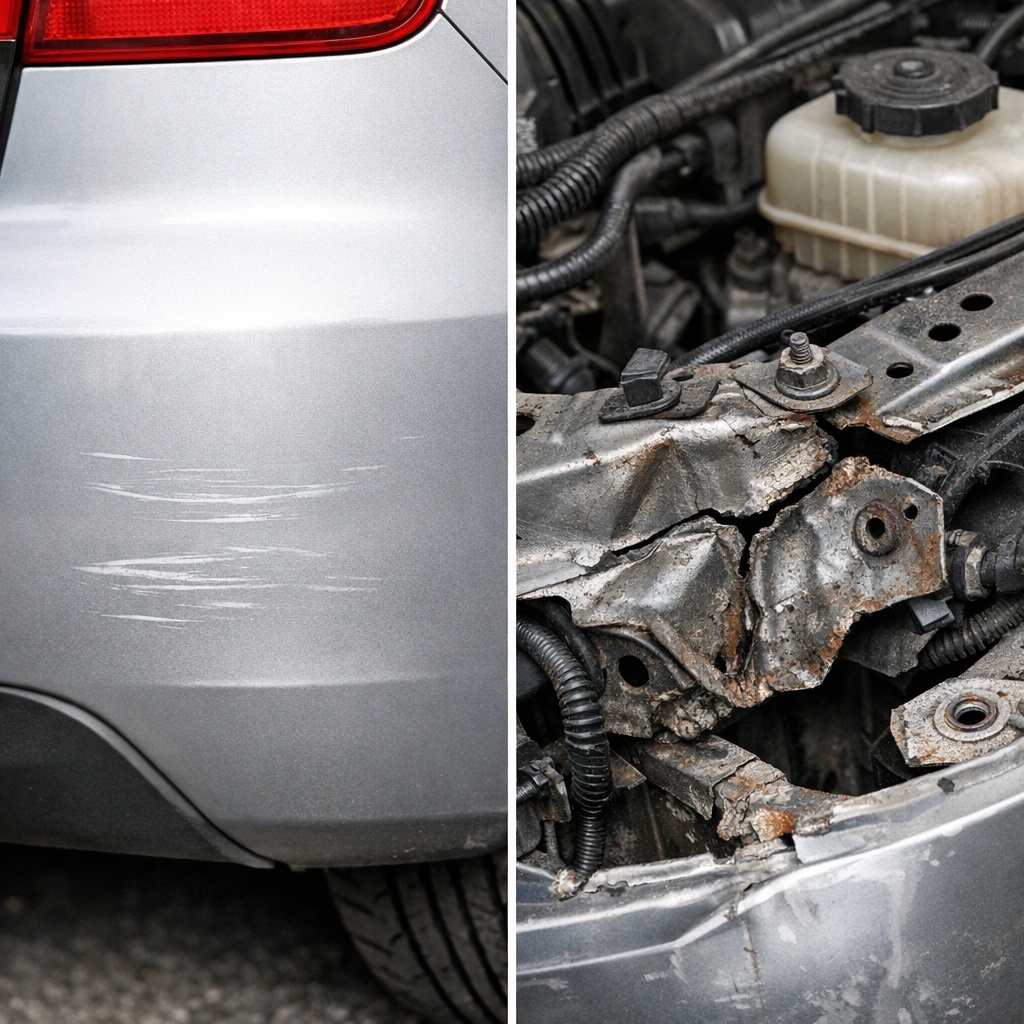
Not all minor damage is created equal. The distinction that matters most is whether the damage was purely cosmetic or whether it potentially affected structural integrity.
Cosmetic Minor Damage (Low Risk)
- Door dings and parking lot dents
- Bumper scuffs from low-speed contact
- Scratches and paint chips
- Cracked or chipped windshield
- Broken side mirror
- Hail damage to body panels
- Curbed wheels
This kind of damage is the automotive equivalent of a scraped knee. It looks worse than it is, it heals with proper treatment, and it leaves little to no lasting impact on the vehicle’s safety or reliability.
Potentially Concerning “Minor” Damage (Higher Risk)
- Front or rear impact — even at low speed — that affected the bumper reinforcement bar
- Damage near the frame rails or unibody structure
- Bent suspension components from hitting a pothole or curb at speed
- Minor flood or water intrusion to the interior
- Damage that triggered an insurance claim disproportionate to visible damage
This category is where “minor” gets misleading. The damage might look minor from the outside — a small crease in a fender, a slightly misaligned bumper — but underneath, components that matter for crashworthiness and handling could be compromised.
When It’s Safe to Buy a Car With Minor Damage
After looking at hundreds of these situations, patterns emerge. Here are the circumstances where minor damage on Carfax shouldn’t stop you:
- The damage was clearly cosmetic — parking lot dent, bumper scuff, hail damage — and the repair was straightforward.
- The repair was done at a reputable shop — franchise dealer, certified collision center, or well-reviewed independent facility.
- The seller is transparent — they can tell you exactly what happened, where it was repaired, and provide documentation.
- A pre-purchase inspection confirms the repair quality — an independent mechanic finds no ongoing issues related to the damage.
- The price reflects the history — you’re getting a fair discount compared to similar vehicles without damage reports.
- The rest of the Carfax is clean — no title issues, consistent ownership, regular maintenance, no other red flags. If you’re unsure what a spotless report really signals, what “clean Carfax” actually means is worth understanding before you use it as a benchmark.
If all six of those boxes check out, you’re likely looking at a good deal that other buyers are irrationally avoiding.
When You Should Walk Away
And here are the situations where that “minor damage” entry should send you looking elsewhere:
- The seller can’t or won’t explain what happened — evasiveness about damage history is never a good sign.
- The repair quality is visibly poor — mismatched paint, uneven panel gaps, orange peel texture, or overspray on trim pieces.
- A mechanic finds related issues during inspection — pulling to one side, unusual tire wear, suspension noises, or alignment problems that trace back to the reported damage.
- There’s more than one damage entry — multiple incidents, even if each is classified as minor, suggest the car has had a rough life.
- The price isn’t discounted — if the seller wants full market value for a car with damage history, they’re not being reasonable. Move on.
- Your gut says something is off — experienced buyers develop instincts. Trust yours.
How Minor Damage on Carfax Affects Resale Value

Let’s talk money, because that’s often the real question behind “should I buy this car?”
A vehicle with minor damage on Carfax will typically sell for 5% to 15% less than a comparable vehicle with a completely clean history. The exact discount depends on the type of damage, the vehicle’s age, its overall condition, and your local market.
Here’s what that means practically:
- On a $20,000 car, expect it to be priced $1,000 to $3,000 lower than identical clean-title examples.
- On a $35,000 car, the discount could be $1,750 to $5,250.
That discount can work in your favor as a buyer — you get a solid car at a below-market price. But understand that you’ll face the same discount when you sell. The Carfax entry follows the VIN forever. Every future buyer will see it, and every future buyer will factor it into their offer. For a deeper look at whether minor damage on Carfax is actually a problem, the full picture helps.
If you plan to drive the car for many years, the resale discount matters less. If you’re planning to flip it in two years, factor the permanent value reduction into your purchase decision.
Damage Level Comparison
| Factor | Minor Damage | Moderate Damage | Major Damage |
|---|---|---|---|
| Typical Cause | Parking lot incident, fender bender, hail | Significant collision, multiple panel damage | High-speed crash, rollover, structural hit |
| Structural Risk | Very low | Moderate | High |
| Resale Impact | 5–15% reduction | 15–30% reduction | 30–50%+ reduction |
| Airbag Deployment | Unlikely | Possible | Likely |
| Title Impact | Clean title maintained | Usually clean, sometimes branded | Often salvage or rebuilt title |
| Buyability | Generally safe with inspection | Proceed with extreme caution | Avoid unless expert-verified |
This comparison makes one thing clear: minor damage occupies a very different risk category than moderate or major damage. Lumping them together — which many buyers instinctively do — leads to missed opportunities on perfectly good vehicles.
Insurance and Hidden Risks You Should Know About
One question buyers rarely ask but absolutely should: will prior minor damage affect my insurance?
In most cases, no. Insurance companies base your premiums on the vehicle’s current condition, your driving history, your location, and the car’s make and model — not on whether it had a bumper scuff three years ago. However, there are nuances:
- Pre-existing damage exclusions — Some insurers will note prior damage during the policy setup and may exclude coverage for related pre-existing issues. If the car had front-end minor damage and you later have a front-end claim, they could argue the damage was pre-existing.
- Diminished value claims — If you’re ever in an accident with this car and file a diminished value claim, the prior damage history will reduce your payout. The car’s “before” value is already lower because of the Carfax entry.
- Gap insurance calculations — If you’re financing and the car is totaled, gap insurance pays the difference between the car’s value and your loan balance. A prior damage report lowers the car’s assessed value, potentially leaving you exposed.
None of these are dealbreakers, but they’re worth understanding before you commit. The Insurance Information Institute provides helpful breakdowns of how different coverage types work and what affects your policy.
Real-Life Scenarios: Good Deal vs. Bad Deal
Scenario 1: The Smart Buy
A 2021 Honda CR-V with 38,000 miles shows “Minor Damage Reported — Rear” on Carfax. The seller explains someone backed into the car in a grocery store parking lot, cracking the rear bumper cover. It was repaired at a Honda-certified collision center. The seller has the repair invoice showing a bumper cover replacement and respray — total cost $1,400. The car is priced $2,500 below comparable clean-history CR-Vs. A pre-purchase inspection reveals no issues.
Verdict: Buy it. You’re saving $2,500 on a car that had a bumper replaced. The repair was professional, documented, and purely cosmetic. This is exactly the kind of deal savvy buyers look for.
Scenario 2: The Trap
A 2020 Toyota Camry with 45,000 miles has “Minor Damage Reported — Front” on Carfax. The seller says “it was just a little scratch.” But during your inspection, you notice the hood doesn’t sit flush, the headlights look newer than they should, and there’s slight overspray on the fender liner. The paint thickness gauge shows one fender at double the reading of the others. The seller has no repair documentation and gets defensive when asked for details.
Verdict: Walk away. What was reported as “minor” was almost certainly more significant than disclosed. The physical evidence contradicts the seller’s story, and the lack of documentation removes any ability to verify the repair quality.
Myth vs. Truth: Minor Damage on Carfax
Myth: “Minor damage on Carfax means the car is unsafe.”
Truth: Minor damage reports overwhelmingly involve cosmetic issues — scratches, dents, bumper scuffs — that have zero impact on the vehicle’s safety systems, structural integrity, or mechanical reliability. The car went through a low-severity incident and was repaired.
Myth: “You’ll never be able to resell a car with damage on Carfax.”
Truth: You absolutely can resell it. Millions of vehicles with minor damage histories change hands every year. You’ll likely sell for slightly less than an identical car with a spotless report, but if you bought at a discount for the same reason, you break even on the depreciation difference.
Myth: “The damage must have been worse than what’s reported.”
Truth: Not necessarily. Insurance companies have standardized classification systems, and minor damage has specific thresholds. Could something occasionally be misclassified? Sure. But the system generally works, and a pre-purchase inspection will reveal any discrepancies between the report and reality. It’s also worth knowing that many body shops never report repairs to Carfax at all, which is why physical evidence matters more than the classification label.
Myth: “Banks won’t finance a car with damage on Carfax.”
Truth: Banks and credit unions finance vehicles with minor damage reports every day. What they won’t finance — or will charge higher rates for — are vehicles with salvage or rebuilt titles. A clean title car with a minor damage note is financed like any other used car.
Pro Tips Most Buyers Don’t Know
- Use the damage location to your advantage. “Minor Damage — Rear” on a car you’ve physically inspected with no visible issues? That’s likely a reversing incident where someone tapped the bumper. Rear cosmetic damage is the least concerning type.
- Check the claim amount if you can access it. An insurance claim under $2,000 for “minor damage” is consistent with the classification. A claim of $5,000+ labeled “minor” should raise your eyebrows — that’s a lot of money for something supposedly trivial.
- Run the VIN through multiple history services. Different providers access different databases. What one service calls “minor,” another might provide more detail on. An affordable VIN lookup lets you pull comprehensive reports that may surface details a single source missed.
- Ask the seller to show you exactly where the damage was. A seller with nothing to hide will walk you to the car and point to the spot. A seller who can’t remember where “minor damage” occurred on their own car is either lying or didn’t own it when the damage happened — both are worth noting.
- Negotiate with data, not emotion. Don’t just say “Carfax shows damage, knock off $3,000.” Instead, pull comparable listings of the same car without damage reports and show the seller the market price difference. Data-driven negotiation gets results.
How to Verify the Full Story Before Buying
The Carfax entry gives you a starting point. Your job is to fill in the rest of the story before making a commitment.
Step 1: Pull a Comprehensive VIN Report
Start at CarfaxVINLookup.com and run the vehicle’s VIN. If you’re screening multiple vehicles and budget is a consideration, it’s worth knowing your options for accessing free vehicle history data before paying for individual reports. Look beyond just the damage entry — check for title status, ownership history, odometer consistency, service records, and any other flags. A minor damage report on an otherwise pristine history reads very differently than one surrounded by gaps and inconsistencies.
Step 2: Physically Inspect the Damage Area
If the report says “Minor Damage — Left Side,” examine the entire left side of the vehicle carefully. Look for paint texture differences, panel misalignment, new hardware on old parts, and overspray. Bring a paint thickness gauge if you have one — readings that vary by more than 30-40 microns between panels usually indicate repaint work.
Step 3: Get a Professional Pre-Purchase Inspection

This is the step that separates smart buyers from hopeful ones. An independent mechanic will put the car on a lift, check for frame damage, verify suspension geometry, and identify any repair work — good or bad. Spend the $150-$300. It’s the best insurance policy you’ll never file a claim on.
Step 4: Request Repair Documentation
Ask the seller for repair receipts, insurance claim documents, or shop records related to the reported damage. Transparency here is a strong positive signal. Resistance or inability to produce anything is a moderate negative signal.
Frequently Asked Questions
Should I buy a car with minor damage on Carfax?
In many cases, yes — if the damage was cosmetic, properly repaired, and the price reflects the history. Always get a pre-purchase inspection and verify the vehicle’s full history through a VIN check at CarfaxVINLookup.com before committing.
Does minor damage on Carfax mean the car was in an accident?
Not always in the way most people think. “Minor damage” can include parking lot incidents, hail damage, vandalism, and other non-collision events. It indicates that some form of damage was reported to an insurance company or data source, but it doesn’t necessarily mean a traditional traffic accident occurred.
Will minor damage on Carfax lower my car’s value?
Yes, typically by 5% to 15% compared to an identical vehicle without a damage report. This discount is permanent — the entry stays on the Carfax report for the life of the VIN.
Can I get insurance on a car with minor damage on Carfax?
Yes. Insurance companies insure vehicles with minor damage histories without issue. Your premiums are based on current condition, your driving record, and the vehicle’s specifications — not on a previous minor damage report.
What’s the difference between minor damage and an accident on Carfax?
Carfax may report both separately. “Accident Reported” indicates a collision event was logged, while “Minor Damage” is a severity classification. A single incident might show as both “Accident Reported” and “Minor Damage,” meaning a collision occurred but the resulting damage was classified as minor.
How can I find out what the minor damage actually was?
Ask the seller directly, request repair receipts, and run a comprehensive VIN report through multiple services. Some reports include claim details or repair descriptions. A physical inspection by a mechanic can also reveal the nature and extent of previous repairs.
Do dealerships disclose minor damage on Carfax before selling?
Reputable dealerships typically provide a Carfax report or similar vehicle history report as part of the sales process. However, they’re not always required to proactively highlight every entry. It’s your responsibility to read the report thoroughly and ask questions about anything you don’t understand.
The Bottom Line
A “Minor Damage” entry on Carfax isn’t the deal-killer most buyers assume it is — but it’s not something to ignore either. It’s information, and smart buyers use information to their advantage.
If the damage was cosmetic, the repair was done properly, the seller is transparent, and the price is right, you could be looking at one of the best deals on the lot. If any of those pieces are missing, keep looking.
Before you make your decision, run a full VIN check at CarfaxVINLookup.com to see the complete picture. Pair that with a hands-on inspection and a trusted mechanic’s opinion, and you’ll know — not guess — whether that minor damage is truly minor or a sign of something bigger hiding beneath the surface.