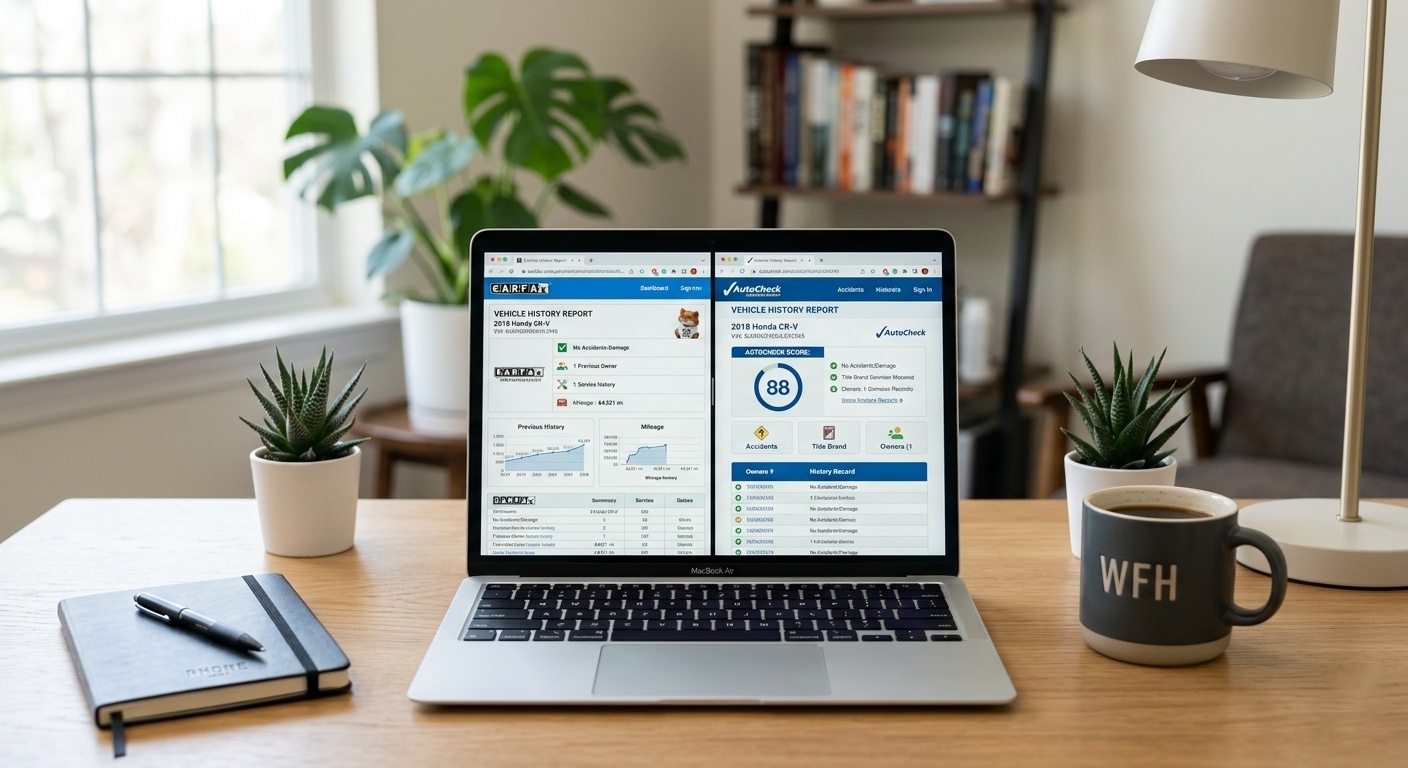
You’ve found a used car you’re interested in, and now you want to check its history before handing over your money. You search for a vehicle history report and immediately hit the same question every buyer faces: Carfax or AutoCheck? They both promise to reveal a vehicle’s past. They both cost money. And neither one tells you upfront exactly how they’re different — or which one actually serves you better.
After years of pulling both reports side by side on the same vehicles, the answer isn’t as simple as “this one is better.” Each service has genuine strengths, real blind spots, and specific situations where it outperforms the other. Here’s what you actually need to know.
Quick Answer: Carfax or AutoCheck?
Neither service is universally better. Carfax provides deeper insurance-reported accident detail and stronger dealership service records. AutoCheck offers better auction history data and a proprietary scoring system that simplifies comparisons. For the most complete picture, smart buyers use both — because each service accesses data sources the other doesn’t.
What Each Service Actually Does

Carfax
Carfax has been in the vehicle history business since 1984 and has built the most recognized brand in the space. They aggregate data from over 100,000 sources including insurance companies, state DMVs, franchise dealerships, law enforcement agencies, and auction houses.
Their reports emphasize:
- Detailed accident narratives — Severity classifications (minor, moderate, major), damage locations, and whether airbags deployed
- Franchise dealership service records — Oil changes, brake work, tire rotations, recall completions, and warranty repairs from participating dealers
- Ownership timeline — Number of owners, type of use (personal, rental, fleet), and duration of ownership
- Title history — Salvage, rebuilt, flood, lemon, and junk title brands from state DMV records
- Buyback Guarantee — Carfax offers to purchase the vehicle if the report missed a salvage or lemon title brand
Carfax’s biggest advantage is its depth of insurance and dealership data. Decades of data-sharing agreements with major insurance carriers mean that when an accident goes through an insurance claim, Carfax typically captures more granular detail about what happened. Understanding what Carfax gets right and where it falls short is essential before relying on any single report.
AutoCheck
AutoCheck is owned by Experian, one of the three major credit bureaus. This corporate parentage gives them access to data channels that differ from Carfax’s network, particularly in the auction and financial sectors.
Their reports emphasize:
- AutoCheck Score — A proprietary 1–100 numerical rating that compares the vehicle against similar models, making apples-to-apples comparison easier
- Auction data depth — Experian’s connections to major auction houses (Manheim, ADESA) often surface more detailed auction records
- Title history — Same DMV-sourced data as Carfax, with comparable coverage of salvage, rebuilt, and flood brands
- Accident history — Insurance-reported accidents, though typically with less narrative detail than Carfax
- Odometer readings — Mileage checkpoints from service visits, inspections, and registration events
AutoCheck’s strongest differentiator is its scoring system. While Carfax presents raw data and lets you interpret it, AutoCheck distills the vehicle’s history into a number that’s immediately comparable to other vehicles in the same class. For buyers evaluating multiple cars simultaneously, this simplification has real value.
Head-to-Head Comparison
| Feature | Carfax | AutoCheck |
|---|---|---|
| Accident detail depth | Stronger — More granular severity and location data | Good — Reports accidents but with less narrative |
| Service records | Stronger — Deep dealership maintenance data | Limited — Fewer dealership partnerships |
| Auction history | Good — Covers major auctions | Stronger — Experian’s auction data is more detailed |
| Vehicle scoring | None — Raw data only | Stronger — AutoCheck Score (1–100) |
| Title history | Comprehensive | Comprehensive |
| Odometer checks | Comprehensive | Comprehensive |
| Buyback guarantee | Yes — For missed title brands | No |
| Single report price | $44.99 | $24.99 |
| Unlimited plan | $99.99 (60 days) | $49.99 (30 days) |
| Brand recognition | Dominant — Industry standard | Growing — Strong among dealers |
Where Carfax Wins
Accident Detail and Insurance Data
Carfax’s longest-standing advantage is the depth of its insurance company relationships. When a vehicle is in an accident and a claim is filed, Carfax typically receives more detailed information about the type of damage, the area of impact, the severity classification, and whether supplemental restraint systems (airbags) were triggered.
AutoCheck reports the same accident, but often with less context. You might see “Accident Reported” on AutoCheck where Carfax shows “Minor Damage — Rear End — No Airbag Deployment.” For a buyer trying to assess risk, that additional detail changes the calculus entirely.
Dealership Service Records
Carfax has spent decades building data-sharing agreements with franchise dealership networks. The result is a service history section that can show you every oil change, brake job, and tire rotation performed at a participating dealer. AutoCheck’s service record coverage exists but is noticeably thinner — they simply don’t have the same breadth of dealership partnerships.
For buyers who value maintenance history as a proxy for how well a car was cared for, this is a meaningful difference.
The Buyback Guarantee
Carfax offers to repurchase a vehicle if their report failed to disclose a salvage or lemon title brand that existed at the time of sale. It’s not comprehensive insurance — it covers specific title brand misses, not hidden damage — but it’s a form of accountability that AutoCheck doesn’t offer. For buyers worried about whether a clean report can truly be trusted, the guarantee provides a modest safety net.
Where AutoCheck Wins
The AutoCheck Score
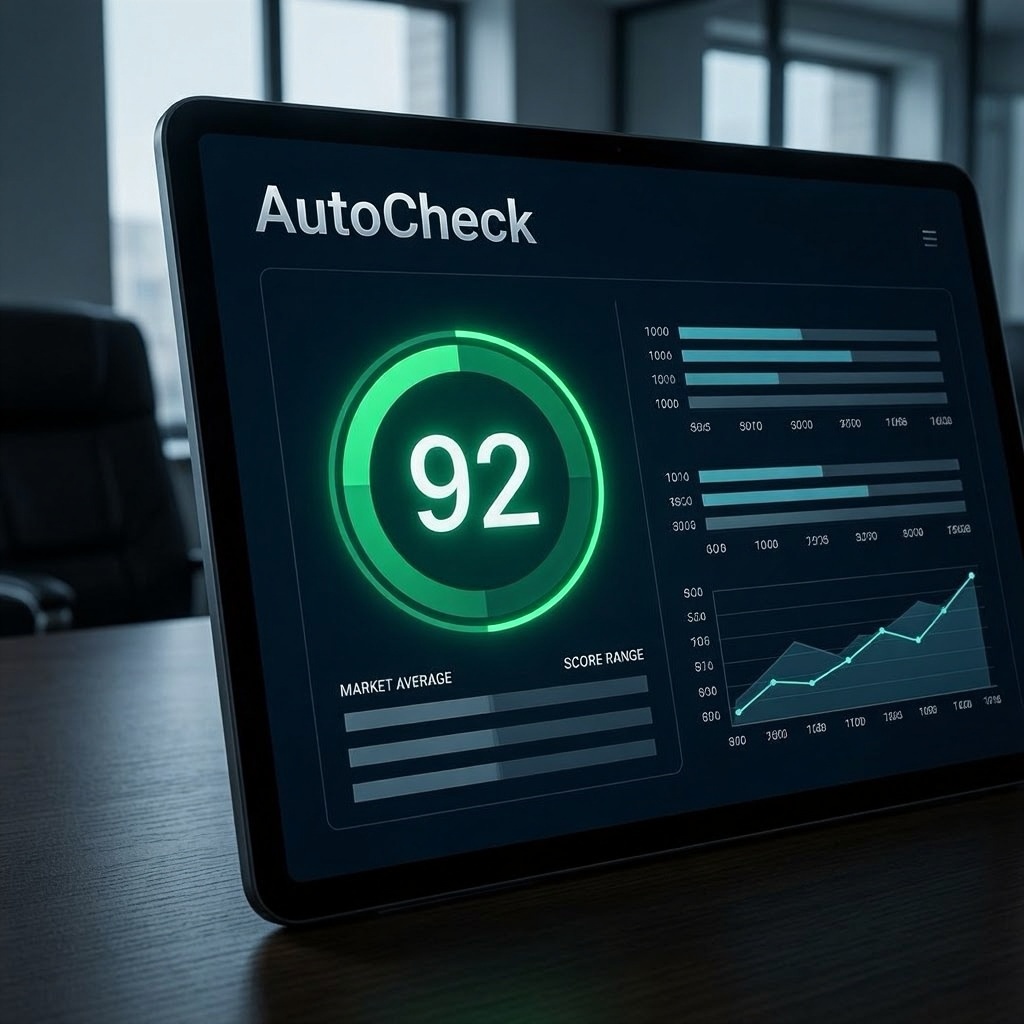
This is AutoCheck’s killer feature. The numerical score (1–100) compares the specific vehicle against similar vehicles in terms of age, mileage, reported events, and title history. A score of 85 on a 2019 Honda Civic means it compares favorably against other 2019 Civics in the database.
Why does this matter? Because raw data requires interpretation, and most buyers aren’t experts at reading vehicle history reports. The score provides immediate, intuitive context. It doesn’t replace careful analysis — a high-scoring car can still have issues the score doesn’t capture — but it makes initial screening across multiple vehicles significantly faster.
Auction Data
Experian’s corporate reach gives AutoCheck stronger connections to major wholesale auction platforms. If a vehicle passed through a dealer auction — where problem cars often end up — AutoCheck is more likely to surface those records with detail about condition grades, announcements, and sale prices.
For buyers who want to know whether a car was wholesale-auctioned (and potentially why), AutoCheck has an edge. Auction history can reveal that a dealer took a car as a trade-in and decided it wasn’t worth selling retail — a signal that deserves attention.
Price
At roughly half the cost of a Carfax report, AutoCheck is the more budget-friendly option. For buyers checking multiple vehicles during their search — which you absolutely should be doing — the price difference adds up. AutoCheck’s unlimited plan is also significantly cheaper, making it practical to screen a large number of candidates before narrowing your list. For full context on what Carfax charges and whether it’s worth the premium, the pricing structure is worth examining before you commit to multiple reports.
What Both Services Miss
Here’s the part that matters more than the Carfax-vs-AutoCheck debate itself: both services share the same fundamental limitation. They can only report what was reported to them.
Neither Carfax nor AutoCheck will show you:
- Cash repairs — Accidents handled privately without insurance claims
- Independent shop work — The majority of independent mechanics and body shops don’t report to either service
- Mechanical condition — Neither service tells you how the car runs today
- Flood damage without a title brand — Vehicles with moderate water exposure that weren’t declared total losses
- Cosmetic repairs — Repainting, dent removal, and bodywork done outside of formal channels
The National Highway Traffic Safety Administration regularly warns consumers that vehicle history reports — regardless of provider — are starting points, not guarantees. The data is valuable. But it’s never complete.
This shared limitation is exactly why the smartest approach isn’t picking one service over the other. It’s using multiple data sources and combining digital records with physical verification.
When to Use Carfax
- You’re down to your final one or two candidates and want maximum detail
- The vehicle’s service history is important to your decision
- You want the Buyback Guarantee for title brand protection
- You’re buying from a dealer who provides Carfax reports (many do for free)
- Accident detail — severity, location, airbag status — matters to your evaluation
When to Use AutoCheck
- You’re screening multiple vehicles and need a cost-effective way to compare them
- You want a quick numerical score to rank candidates before deeper research
- The vehicle likely passed through a dealer auction and you want that history
- You’re comparison shopping and want a consistent scoring framework
- Budget is a factor and you need reliable data at a lower price point
The Smart Buyer’s Approach: Use Both
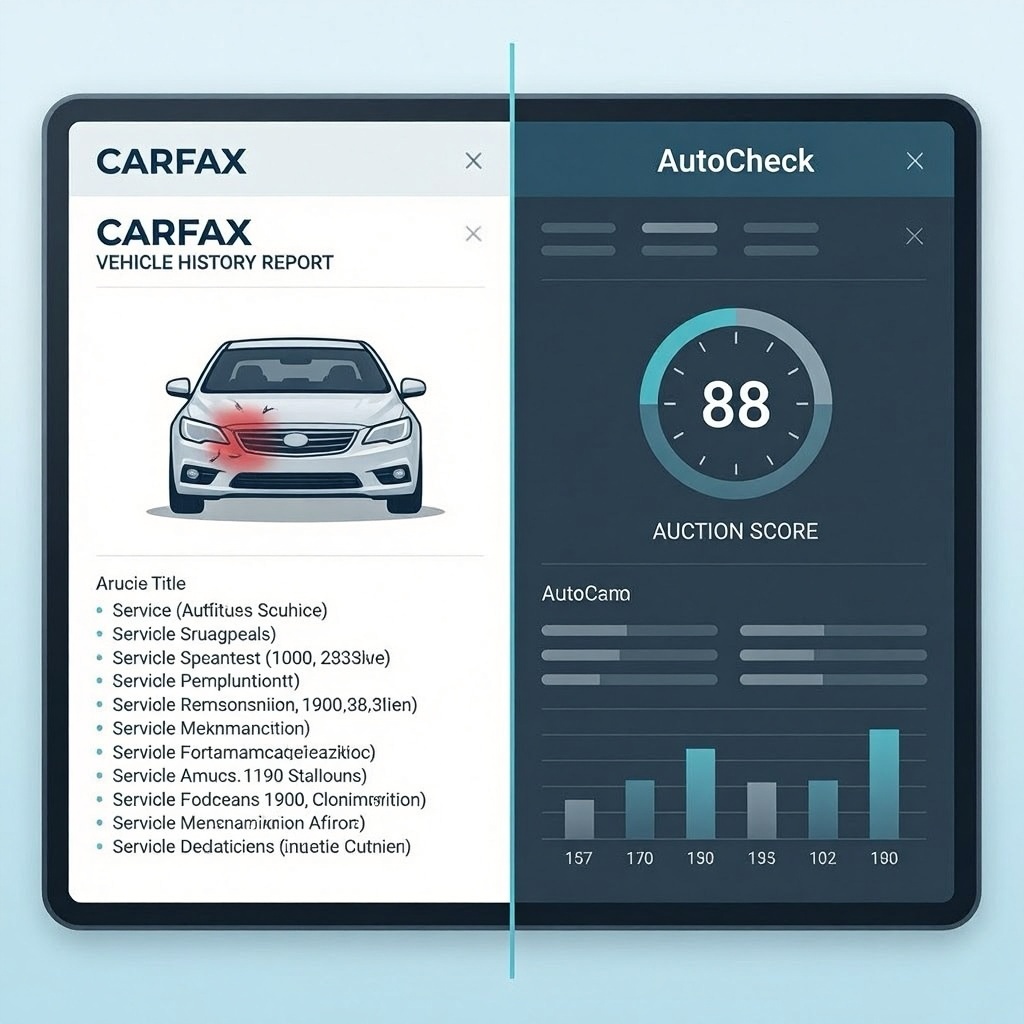
The buyers who get the best outcomes don’t pick a side. They use a layered approach:
- Stage 1: Screen broadly. Use AutoCheck’s unlimited plan to score and filter multiple vehicles quickly. Eliminate obvious problems — title brands, major accidents, odometer issues — before investing time in deeper research.
- Stage 2: Go deep on finalists. Pull a Carfax report on your top one or two candidates. Examine the accident detail, service history, and ownership timeline with the kind of attention that matters when you’re about to write a check.
- Stage 3: Cross-reference. Run the VIN through a service that lets you check a car’s history alongside both major services. Different databases surface different events. An accident that appears on one report might show more detail — or might only appear — on another.
- Stage 4: Verify physically. No report replaces a pre-purchase inspection. Budget $150–$300 for an independent mechanic to examine the vehicle on a lift. This catches everything that no database can.
Common Mistakes Buyers Make
1. Using only one service and assuming it’s complete. Each service has different data partnerships. Running only Carfax or only AutoCheck leaves potential gaps. An accident reported to one might not appear on the other — and vice versa.
2. Confusing the AutoCheck Score with a condition guarantee. The score compares reported history against similar vehicles — it doesn’t assess current mechanical condition, hidden repairs, or unreported events. A score of 90 doesn’t mean the car is in 90% perfect condition.
3. Assuming a clean report from either service means no problems. Both services report what was formally reported to them. Cash repairs, private settlements, and work at non-reporting shops bypass the system entirely. A vehicle can have a perfect score on AutoCheck and a spotless Carfax while hiding significant undocumented body work.
4. Skipping the report entirely because the dealer said the car is fine. “Clean Carfax” has become a sales phrase. Dealers use it to build confidence. But those two words are no substitute for actually reading the report yourself and understanding what each entry — and each absence — means.
5. Ignoring the Carfax report because it’s expensive. The cost of a Carfax report is roughly 0.1% to 0.3% of a typical used car purchase price. Skipping it to save $45 while spending $25,000 is not strategic frugality — it’s misplaced economy. If budget is a concern, understanding your free carfax report options can help you access critical data without overspending.
Myth vs. Truth
Myth: Carfax has more data than AutoCheck on every vehicle.
Truth: Carfax leads in insurance accident detail and dealership service records. AutoCheck leads in auction data and often surfaces events from Experian’s financial reporting network that Carfax doesn’t capture. Neither consistently has “more” data — they access different pools.
Myth: If AutoCheck shows a clean score, the car is safe to buy.
Truth: The AutoCheck Score reflects reported history only. It’s a useful comparison tool, not a safety certification. Unreported damage, mechanical issues, and gaps that exist across all vehicle history services apply equally to AutoCheck.
Myth: Dealers always provide the most favorable report.
Truth: Some dealers do cherry-pick which report to show — displaying the one with fewer entries. This isn’t necessarily deceptive (different services genuinely capture different events), but it’s why pulling your own report independently is important. You want the most complete picture, not the cleanest-looking one.
Myth: You don’t need both — one is always enough.
Truth: For a $20,000+ purchase, spending an extra $25 to cross-reference with a second service is the most cost-effective risk reduction available. Events that appear on one report and not the other happen more often than most buyers expect.
Pro Tips for 2026 Buyers
- Check if the dealer provides a free report first. Many dealerships offer complimentary Carfax or AutoCheck reports with their listings. Use the free one, then pay for the other service independently to cross-reference. Two reports for the price of one.
- Look for report inconsistencies, not just red flags. If Carfax shows two owners and AutoCheck shows three, that’s a data discrepancy worth investigating. If one report shows an accident and the other doesn’t, dig into the timeline.
- Use the AutoCheck Score for quick filtering, not final decisions. Screen your initial list using scores to eliminate obvious problems. Then invest in detailed Carfax reports on your top picks for the nuance that a numerical score can’t provide.
- Don’t forget NMVTIS. The National Motor Vehicle Title Information System is a federal database that both Carfax and AutoCheck draw from, but you can also access it through approved providers for a few dollars. It’s the definitive source for title brand information.
- Always pair any report with a physical inspection. A paint thickness gauge costs $30. A pre-purchase inspection costs $200. Together, they catch problems that no vehicle history report — from any provider — can reveal.
The Bottom Line
Carfax and AutoCheck aren’t competitors in the way Coke and Pepsi are — where picking one gives you essentially the same thing as the other. They access different data networks, present information differently, and each catches things the other misses. Carfax gives you deeper storytelling around accidents and maintenance. AutoCheck gives you faster comparison tools and better auction visibility.
The real question isn’t which one is better. It’s whether you’re willing to spend an extra $25 to check both — and an extra $200 for a mechanic to tell you what neither report can. For a purchase that will cost you thousands of dollars and serve as your daily transportation, that layered approach isn’t overcautious. It’s the minimum standard for buying smart.