
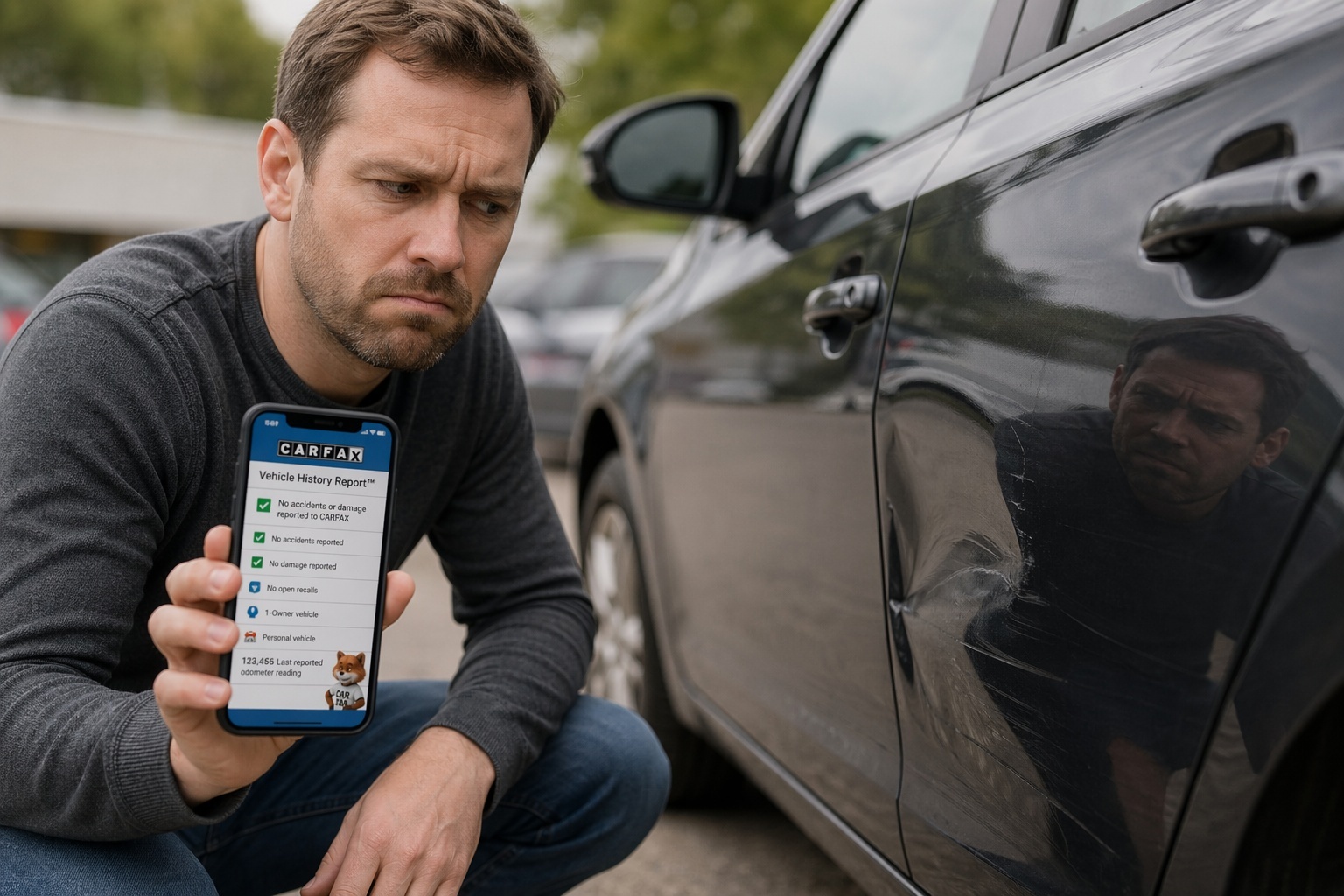
You pulled the Carfax. It’s clean. No accidents. No damage. No red flags. You feel good about the car — until a mechanic puts it on a lift and finds mismatched paint, aftermarket headlights, and a radiator support that’s clearly been replaced. The car was in a collision. The Carfax simply doesn’t know about it.
This scenario isn’t rare. It’s not a Carfax glitch or a system failure. It’s a structural reality of how vehicle history data is collected, and it happens far more often than most buyers realize. Understanding why accidents go unreported — and knowing how to detect the evidence anyway — is the difference between buying with confidence and buying blind.
Quick Answer: Why Don’t Some Accidents Appear on Carfax?
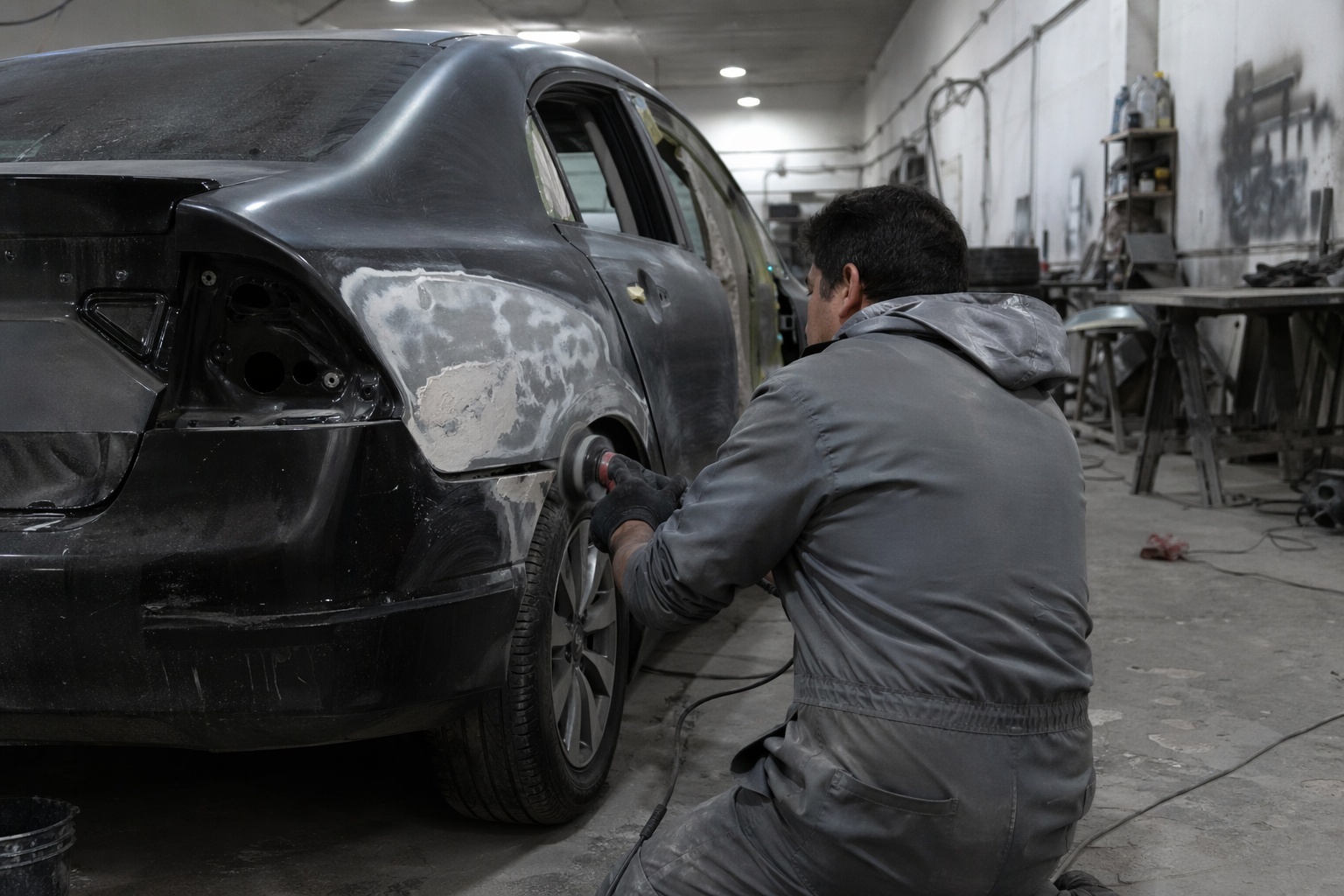
Carfax can only report accidents that are formally documented through their data sources — insurance claims, police reports, participating repair facilities, and state agencies. When an accident is handled privately, repaired without an insurance claim, or fixed at a shop that doesn’t share data with Carfax, the event never enters their database. The accident happened. The report just doesn’t reflect it.
How Carfax Collects Its Data
To understand the gaps, you first need to understand the pipeline. Carfax aggregates vehicle history data from over 100,000 sources, including:
- Insurance companies — The largest source of accident data. When a claim is filed, the insurer reports the event.
- State DMVs — Title transfers, registration events, title brands (salvage, rebuilt, flood).
- Law enforcement agencies — Police accident reports filed after collisions.
- Franchise dealerships — Service records from manufacturer-affiliated repair centers.
- Auto auctions — Vehicle condition reports and sale records from wholesale auctions.
- Some collision repair facilities — A small percentage of body shops that voluntarily participate in Carfax’s reporting network.
That’s an extensive network. But read that list again carefully. Notice the recurring theme: every data source requires someone to officially report the event. If no one reports it, Carfax has nothing to show. Knowing how to read a Carfax report beyond the surface helps you understand what you’re looking at — but it can’t reveal what was never entered into the system.
Why Accidents Don’t Appear on Carfax: Every Major Reason
1. The Owner Paid Cash and Skipped Insurance
This is the single most common reason accidents go unreported. When an owner handles a collision without filing an insurance claim — paying for repairs out of pocket — the accident bypasses the entire reporting pipeline. No claim means no insurer notification. No insurer notification means no data reaches Carfax.
Why do owners skip insurance? Several reasons:
- They want to avoid premium increases
- The deductible is higher than the repair cost
- They don’t want the accident on their driving record
- They’re driving without adequate coverage
- Both parties agree to settle privately
A $3,000 front bumper repair paid in cash at a neighborhood shop generates zero documentation in any vehicle history database. The car gets fixed. The Carfax stays clean. And the next buyer has no idea.
2. The Body Shop Doesn’t Report to Carfax
The vast majority of independent body shops and collision repair facilities have no data-sharing agreement with Carfax. They’re under no legal obligation to report repairs, and many prefer not to — partially because their customers specifically chose them to keep repairs private.
Even when a repair is extensive — structural work, frame straightening, complete panel replacement — if it’s performed at a non-reporting facility, nothing reaches the database. The quality of the repair might be excellent or terrible, but either way, the Carfax won’t mention it. This reporting gap is one of the most important things buyers need to understand, and the reality of what actually gets documented on vehicle history reports often surprises people.
3. Private Accident Settlements
Two cars collide in a parking lot. Both drivers get out, assess the damage, exchange information — and one writes the other a check on the spot. No police report. No insurance claim. No formal documentation of any kind. The accident is real. The damage was real. But nothing enters any database that Carfax monitors.
Private settlements are extremely common for low-to-moderate damage incidents. Both parties benefit: the at-fault driver avoids a premium increase, and the other driver gets paid immediately without filing a claim. The only party that loses is the future buyer, who has no way to know it happened.
4. No Police Report Was Filed
Police accident reports are a key data source for Carfax. But not every accident generates a police report. In many jurisdictions, law enforcement won’t respond to — or won’t file a report for — minor collisions with no injuries. Parking lot incidents, low-speed fender benders, and single-vehicle impacts often go undocumented by law enforcement entirely.
Even when police do respond, some departments have inconsistent reporting practices. Data transfer from local police databases to state systems (and eventually to Carfax) can be delayed, incomplete, or in some cases, nonexistent. The system depends on consistent participation from thousands of individual agencies, and consistency is exactly what it doesn’t always get.
5. Delayed or Missing Data Transfers
Data doesn’t flow into Carfax in real time. Insurance claims can take weeks to process. Police reports may not reach state databases for months. Service records from dealerships batch-upload on varying schedules. This means a Carfax report pulled today might not reflect an accident that happened last month — or even several months ago.
This timing gap creates a window where a recently damaged vehicle can carry a clean-looking report. If the car changes hands during that window, the new buyer gets a report that’s technically accurate at the time of the pull but doesn’t reflect the vehicle’s true recent history.
6. Out-of-Country Repairs
Vehicles repaired outside the United States — in Canada, Mexico, or overseas — often fall completely outside Carfax’s reporting network. A car that was damaged while being driven in another country and repaired at a foreign facility will likely show nothing on a U.S. Carfax report. This is particularly relevant for vehicles near border regions and those that were previously exported and re-imported.
7. Repairs Classified as Maintenance
Some repairs that result from collision damage are documented — but categorized in ways that don’t trigger an accident flag. A dealer who replaces a bumper cover might log it as a “cosmetic service” rather than an “accident repair.” The work appears in the service history, but without an accident classification, most buyers wouldn’t recognize it as damage-related.
How to Spot Hidden Accident Damage
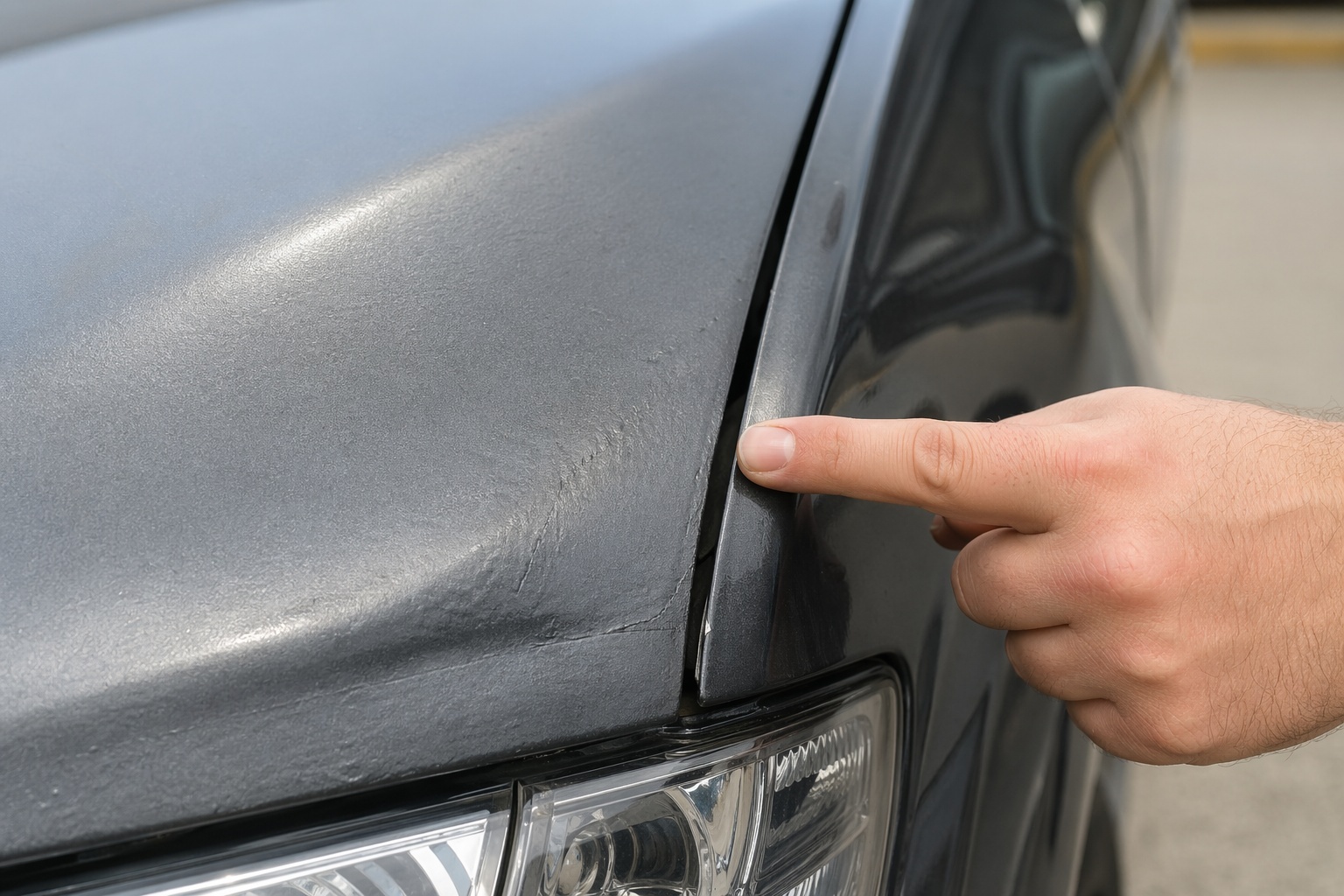
Since you can’t rely solely on any vehicle history report to catch every accident, physical inspection becomes your most important tool. Here’s what to look for:
Paint Inconsistencies
Factory paint has a specific thickness, texture, and finish that’s extremely consistent across all panels. Repainted surfaces — even professional ones — differ from factory. Look for:
- Color variations — View the car in direct sunlight from multiple angles. Repainted panels may appear slightly different in shade, metallic flake density, or clear coat finish.
- Orange peel texture — Factory paint has a characteristic slight texture. Refinished areas may have more or less texture than surrounding panels.
- Overspray — Paint mist on rubber trim, weatherstripping, or in door jamb edges indicates bodywork. Factories don’t create overspray on these surfaces.
- Paint thickness readings — A $30–$50 paint thickness gauge instantly reveals repainted panels. Factory paint typically reads 100–150 microns. Significantly higher readings indicate body filler or multiple paint layers from repair work.
Panel Gaps and Alignment
Factory-assembled vehicles have extremely precise panel gaps — the spaces between doors, hood, trunk, and fenders. After collision repair, achieving factory-perfect alignment is difficult. Check:
- Door-to-fender gaps on both sides — they should be identical
- Hood-to-fender gaps — even spacing on left and right
- Trunk or tailgate alignment — gaps should be uniform
- Headlight and taillight fitment — aftermarket or reseated lights may sit differently
If the gaps on one side of the car are noticeably wider or narrower than the other, something was moved, replaced, or re-hung after damage.
Under-Hood and Under-Body Clues
- Mismatched bolts — Factory bolts have specific markings and finishes. Replaced bolts often look different from originals.
- Fresh undercoating — New undercoating applied over factory coating can indicate repairs being concealed.
- Welding marks — Factory welds are consistent spot welds. Aftermarket repairs often show MIG or TIG welding patterns that look noticeably different.
- Bent or repaired frame rails — Look under the car for signs of bending, straightening, or welded reinforcement on structural members.
VIN Sticker and Label Checks
Every vehicle has VIN labels on major body panels — inside door jambs, on the dashboard, and sometimes under the hood. If panels were replaced during repairs, the original VIN stickers may be missing, replaced, or have paint overspray around their edges. Missing or inconsistent VIN labels are a strong indicator of significant body panel replacement.
Carfax vs. Reality: What the Report Shows vs. What Exists
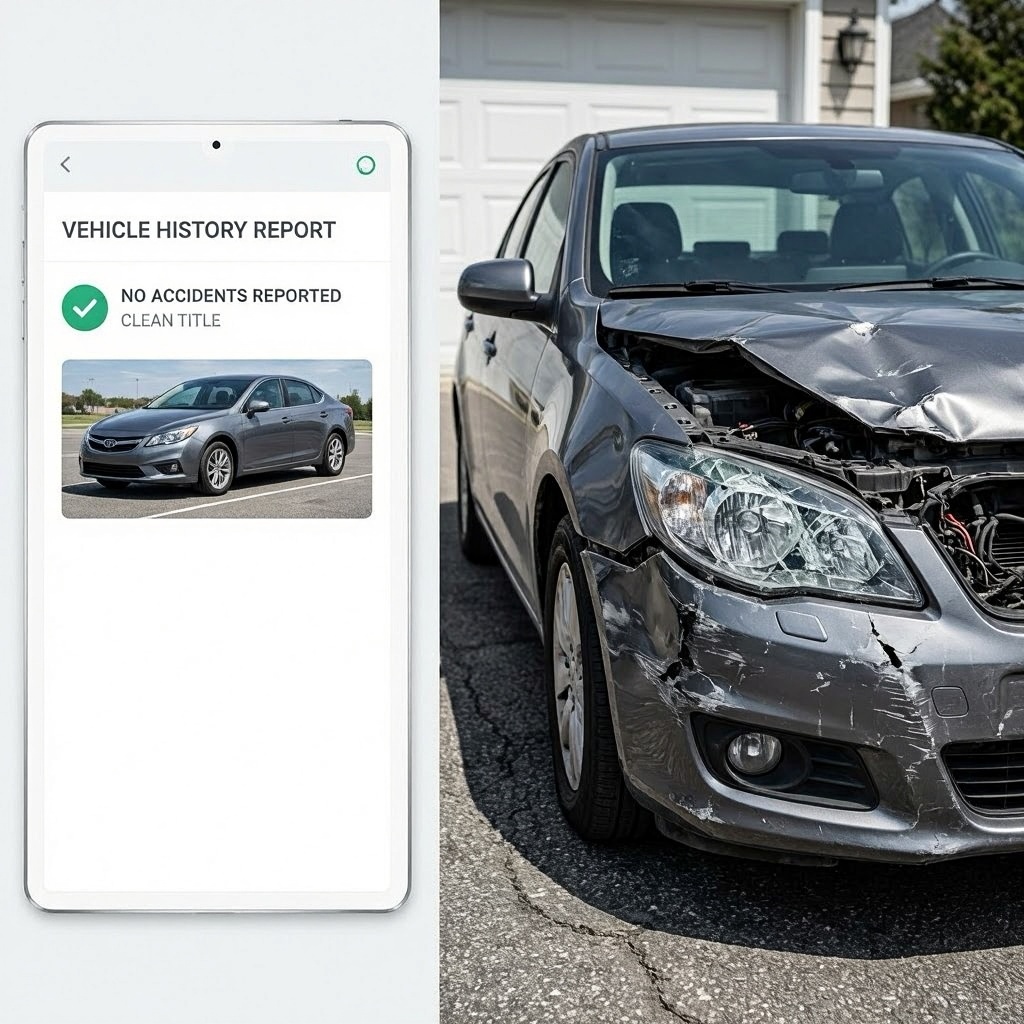
| Carfax Report Shows | Real-World Possibility |
|---|---|
| No accidents reported | Accident occurred but was handled privately or through a non-reporting shop |
| Clean title — no brands | Title may have been washed through a state with weaker reporting requirements |
| Regular service records | Only reflects service at participating facilities — independent shop work is invisible |
| One minor damage report | The reported event may be minor, but additional unreported events could exist |
| No flood history | Vehicle may have had water exposure that wasn’t severe enough to trigger an insurance total loss |
The pattern is consistent: Carfax accurately reflects what’s in their system. But their system only contains what was formally reported. The gap between reported data and reality is where buyers get burned. This is precisely why understanding what a “clean” report actually guarantees — and what it doesn’t — is one of the most important things you can learn before buying a used car.
Real-Life Scenarios
Scenario 1: Clean Report, Hidden Collision
A 2021 Mazda CX-5 listed with a spotless Carfax. Two owners, clean title, regular dealer service records. The asking price is fair — not suspiciously low. The buyer almost skips the inspection but decides to spend $200 on a mechanic’s evaluation. The mechanic finds the entire passenger side has been repainted, the right fender shows signs of replacement, and the door gap on the passenger side is 2mm wider than the driver’s side. The first owner had been sideswiped, paid $5,500 out of pocket at a cousin’s body shop, and never filed a claim. The Carfax couldn’t have known.
Scenario 2: Reported Accident, Safe Vehicle
A 2020 Toyota RAV4 with a “Minor Damage — Rear” entry on Carfax. Most buyers scrolling online listings skip right past it. One buyer investigates: the incident was a low-speed parking lot tap that cracked a bumper cover. The repair was handled at a certified collision center with OEM parts, documented thoroughly, and the vehicle has had three years of clean service records since. The buyer negotiates a $2,000 discount, gets the car inspected independently, and drives away with a better-verified vehicle than most “clean Carfax” cars on the lot.
The lesson is counterintuitive but important: sometimes the car with the entry on its report is the safer purchase, because at least its history is visible.
Myth vs. Truth
Myth: No accident on Carfax means the car was never in an accident.
Truth: It means no accident was reported through Carfax’s data network. Cash repairs, private settlements, non-reporting shops, and unreported police incidents all create real-world accidents that leave zero trace in any vehicle history database. A clean report is encouraging — it is not proof.
Myth: Carfax catches everything eventually.
Truth: If an event never enters the formal reporting system — no claim, no police report, no participating facility — it will never appear on Carfax. There’s no delayed discovery mechanism. Events that bypass the pipeline stay invisible permanently. Running the VIN through multiple vehicle history services helps catch some additional events, but no combination of reports captures everything.
Myth: If a professional body shop repaired it, the repair will show up.
Truth: Professional quality and reporting participation are unrelated. A highly skilled independent body shop can perform flawless structural repair and never report a single detail to Carfax. The quality of the work doesn’t determine whether it’s documented — the shop’s data-sharing agreements do.
Myth: The seller would have to disclose an accident even if it’s not on Carfax.
Truth: Disclosure laws vary significantly by state. Private sellers in many states have minimal legal obligation to disclose damage history. Dealers generally have stricter requirements, but enforcement is inconsistent. Relying on the seller’s honesty — without independent verification — is a gamble that doesn’t always pay off.
Pro Tips: How Smart Buyers Detect What Carfax Can’t
- Invest $30 in a paint thickness gauge. This single tool reveals more about a car’s body condition than any vehicle history report. Measure every panel. Consistent readings mean factory paint. Spikes mean repair work — regardless of what any report says.
- Always inspect in daylight. Artificial lighting hides paint mismatches, texture differences, and color variations. Sunlight reveals everything. Walk around the car slowly and view each panel from multiple angles.
- Run your hand along panel edges. Your fingertips detect surface irregularities that your eyes miss. Ripples, texture changes, and filler beneath paint become obvious through touch even when they’re invisible visually.
- Check the trunk floor and spare tire well. These areas reveal flood damage (water stains, silt, rust) and rear-end collision damage (wrinkled metal, aftermarket sealant, mismatched paint) that cosmetic cleanup on the exterior was designed to hide.
- Run the VIN through multiple sources. Running a complete VIN history check through independent services alongside Carfax and AutoCheck cross-references different databases. Events that appear on one source may be absent from another — and the combined picture is always more complete than any single report.
- Budget for a pre-purchase inspection — no exceptions. A qualified mechanic with a lift, a paint gauge, and experience evaluating used cars will find evidence of collision repair that no database can surface. This $150–$300 investment is the single most effective protection available. The National Highway Traffic Safety Administration recommends independent inspections as a critical step in any used car purchase.
The Bottom Line
Accidents don’t show up on Carfax because Carfax depends on a reporting system that has real, structural gaps. Those gaps aren’t bugs — they’re inherent limitations of a system that relies on voluntary participation from hundreds of thousands of independent businesses, consistent reporting from thousands of government agencies, and formal insurance claims that many vehicle owners deliberately avoid filing.
None of this makes Carfax useless. Their reports provide genuine value and catch problems that would otherwise go unnoticed. But treating a clean Carfax as proof that a car was never damaged is a mistake that costs buyers thousands of dollars every day. For those looking to start the process without a big upfront cost, understanding your free vehicle history check options is a practical first step.
Use the report. Appreciate what it tells you. Then verify what it can’t — with your eyes, a paint gauge, a mechanic on a lift, and the understanding that no database in the world captures every event that happens to a vehicle. The buyers who combine digital records with physical verification don’t end up writing regret-filled forum posts. They drive away informed.